


Borderline personality disorder test
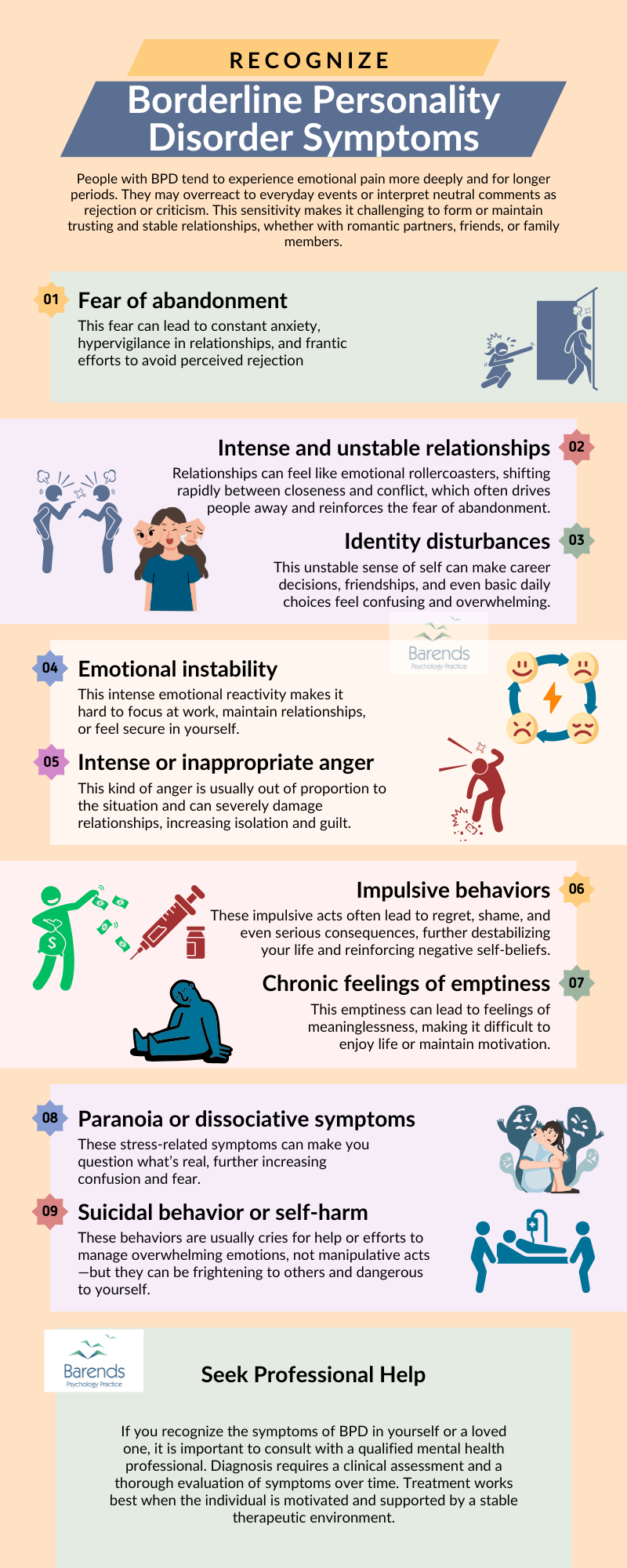
This borderline personality disorder test is designed to help you understand whether you may experience patterns associated with Borderline Personality Disorder (BPD), such as intense emotional reactions, unstable relationships, impulsive behavior, or a strong fear of abandonment. These patterns are explained in more detail on the BPD symptoms page.
Many people take this test because they are trying to make sense of emotional reactions or behaviors that feel difficult to control. You may notice that your emotions shift quickly or that you react strongly in situations that others seem to handle more easily. These experiences can become confusing and overwhelming, especially when they begin to affect daily life or relationship functioning.
This test provides a first indication based on commonly reported BPD symptom patterns. It is not a diagnosis, but it can help you better understand your experiences and decide whether a more structured assessment or professional support may be useful.
After completing the test, you will receive immediate and anonymous results, along with a clear explanation of what your score may mean and possible next steps. The questionnaire is free and takes approximately five minutes to complete.
Scroll down to take the test.
Important note about this BPD screening test
- This is not a diagnosis. It is a screening tool to help you decide whether professional evaluation may be helpful.
- Only a licensed clinician can diagnose BPD and distinguish it from conditions with overlapping symptoms (such as bipolar disorder or trauma-related conditions).
- If you are in immediate danger or experiencing suicidal thoughts, please contact emergency services or a local crisis line.
What is Borderline Personality Disorder?
Borderline Personality Disorder (BPD) is a mental health condition characterized by instability in emotions, relationships, self-image, and impulse control. Many people with BPD experience intense emotional reactions and a strong sensitivity to perceived rejection or abandonment.
Although fear of abandonment is often central, BPD involves a broader pattern of difficulties, including impulsive behavior, identity confusion, and challenges in maintaining stable relationships. These patterns are described in more detail on the BPD symptoms page, where you can explore how these experiences show up in daily life.
In response to emotional distress, some individuals may engage in behaviors such as self-harm, withdrawal or intense attempts to avoid rejection. While these reactions often come from a place of emotional pain, they can unintentionally strain relationships and reinforce feelings of loneliness and self-doubt.
— Niels Barends, MSc, psychologist at Barends Psychology Practice
This can create a repeating cycle of emotional overwhelm and attempts to regain control. Understanding this pattern is an important first step toward breaking it and developing more stable ways of coping.
Jump to
What to do after the test
If your results suggest significant borderline features, especially if relationships or impulsivity are affecting your daily life, getting a professional assessment can make a major difference.
The borderline personality disorder test

Borderline test explanation
Why do relationship patterns feel so intense?
Many people who recognize borderline personality traits notice that their greatest struggles often occur within close relationships. A delayed text message, emotional distance, criticism, or uncertainty about where the relationship stands can trigger powerful emotional reactions.
The Relational Archetypes provide one way of understanding why these reactions may look different from person to person. While they are not a clinical diagnosis, they can help explain the emotional needs and relationship patterns that often become activated under stress.
The Attuner
Attuners naturally focus on emotional connection and closeness. When a relationship feels uncertain, they often move toward the relationship rather than away from it.
Under stress they may become highly sensitive to signs of rejection, distance, or emotional withdrawal.
“Are they upset with me?”
“Did I do something wrong?”
“Why haven’t they replied yet?”
Their greatest strength is emotional awareness. Their challenge is that the need for reassurance can sometimes become stronger than the need for personal stability.
The Anchor
Anchors value predictability and emotional security. Relationships often become extremely important sources of stability.
When trust is threatened, they may experience intense anxiety about losing something they deeply depend on.
“What if they leave?”
“What if I lose this relationship?”
“What if I get hurt again?”
Their strength is loyalty and commitment. Their challenge is that fear of loss can sometimes make it difficult to tolerate uncertainty or change.
Comparison of relationship patterns
| Pattern | Attuner | Anchor |
|---|---|---|
| Core need | Connection and emotional closeness | Security and stability |
| Biggest fear | Emotional disconnection | Loss and abandonment |
| Stress response | Seeking reassurance and dialogue | Seeking certainty and security |
| Relationship blind spot | Over-focusing on the relationship | Over-focusing on preventing loss |
| Growth area | Maintaining boundaries while staying connected | Tolerating uncertainty without excessive fear |
Many people recognize aspects of both patterns. Understanding your dominant relational style can provide valuable insight into how you respond to closeness, rejection, conflict, and emotional uncertainty.
Discover your Relational Archetype
Relationship patterns rarely develop by accident. They often reflect deeper emotional needs, coping strategies, and ways of creating connection and security.
The Relational Archetype Assessment explores the patterns that shape communication, attachment, reassurance seeking, conflict, emotional needs, and relationship dynamics.
Free assessment • Takes approximately 5 minutes • Instant results
Borderline Personality Disorder Test – FAQ
Can this test diagnose Borderline Personality Disorder?
No. This quiz is a screening tool. A formal diagnosis requires a clinical interview by a licensed mental health professional.
What if my score is high?
A high score suggests that a professional assessment may be helpful, especially if you experience unstable relationships or urges toward self-harm.
Can BPD symptoms improve with therapy?
Often, yes. Many people experience greater stability and fewer crisis episodes with appropriate, evidence-based psychotherapy and consistent skill-building.

References
The information on this page is based on established clinical research and diagnostic frameworks for Borderline Personality Disorder (BPD), including evidence-based assessment and treatment approaches. To better understand your symptoms, you can also explore our BPD symptoms page.
- American Psychiatric Association. (2022). Diagnostic and Statistical Manual of Mental Disorders (DSM-5-TR).
- World Health Organization. (2019). International Classification of Diseases (ICD-11).
- Gunderson, J. G. (2011). Borderline Personality Disorder. New England Journal of Medicine, 364(21), 2037–2042.
- Linehan, M. M. (1993). Cognitive-Behavioral Treatment of Borderline Personality Disorder. Guilford Press.
- Bateman, A., & Fonagy, P. (2004). Psychotherapy for Borderline Personality Disorder: Mentalization-Based Treatment. Oxford University Press.