


What is EMDR therapy?
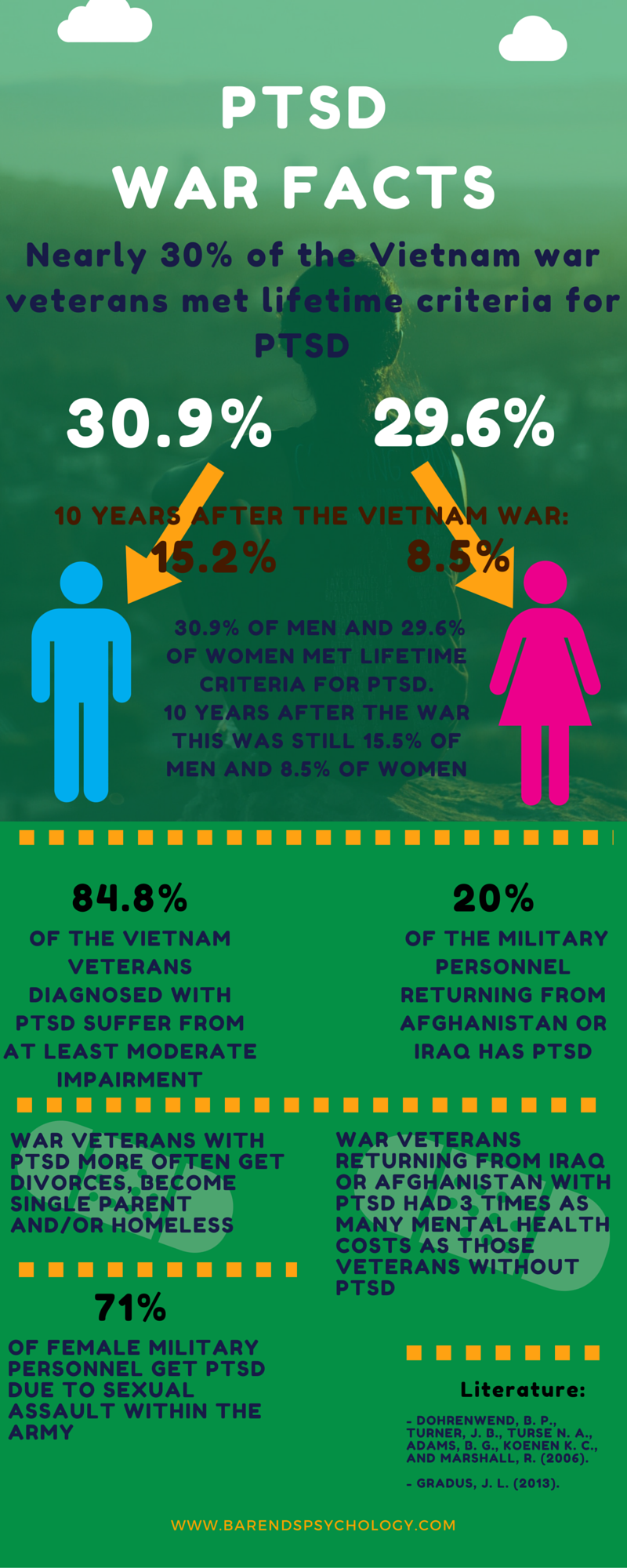
Interesting PTSD war statistics.
Online EMDR therapy is effective for treating post-traumatic stress disorder (PTSD), phobia, anxiety, and traumatic experiences that do not meet the criteria for PTSD. According to the EMDR therapy theory, a traumatic experience becomes a PTSD when the experience is not processed correctly in the brains. This is why people with PTSD have flash backs and nightmares. By shifting the attention from left to right and back (using eye movements, sounds, or hand taps in children), the traumatic experience can be reprocessed in the brains during the sessions. For more detailed information about online EMDR therapy visit my therapy types page.
With online EMDR therapy your traumatic experience is treated fast, effectively, and comfortably. For online EMDR therapy you don’t need to travel to the clinic. You can simply have your sessions in front of the computer or laptop. During an online EMDR therapy session the counselor is always present to ensure everything goes well. With help of the counselor you can process your traumatic experiences.
For more information about PTSD:
- What is Post-traumatic stress disorder?
- The post-traumatic stress disorder symptoms listed.
- What causes PTSD?
- PTSD diagnosis.
- Post-traumatic stress disorder treatment.
- Online PTSD test.
- Interesting PTSD facts.
- Take me back to the homepage.
At Barends Psychology practice, we offer online EMDR treatment. Schedule your first, free of charge, session now. Go to< Contact us and fill in the contact form. (Depending on your health insurance, treatment may be reimbursed)
Why Online EMDR therapy?
Online EMDR therapy is more effective than normal face-to-face EMDR treatment. In our practice more than 80% of the patients are effectively treated for their issues with online EMDR therapy. This is more than the 66% with face-to-face treatment we have in our practice and which is consistent with scientific literature. Online EMDR therapy is probably more effective, because treatment takes place at home, without having a therapist working in your private space and without having the feeling that someone is constantly staring at you. People feel more comfortable at home (compared to in an office), won’t see the therapist during the online EMDR session (the therapist is present), and there is no additional stress of traveling to and fro the clinic. Here is an overview of the advantages of online EMDR therapy:
- Effective: in our practice, online EMDR treatment is as effective as traditional face-to-face EMDR treatment.
- Easy – Online PTSD treatment is easily accessible. Within a week you have your first, free of charge, online session.
- Affordable – Online EMDR therapy is very affordable, because we charge the local fee. Read more about here: Fees and availability.
- Comfortable – Sessions take place in your living room, on your couch, or perhaps even when you are abroad.
- Safe – No need to drive home after an intensive therapy session. Therapists around the world do not recommend you to use a car or bike after a PTSD therapy session.
- Flexible – You can schedule sessions in the weekends or after working hours.
- Good after care – If you have questions in between sessions or after we successfully finished online PTSD treatment, you can contact us at any time. This service is free of charge.
What is PTSD?
Post-traumatic stress disorder (PTSD) is a huge and underestimated problem world wide. Approximately 89% of people experience a traumatic event at one point in their lives [2], [4]. In the United States, between 3.6 and 5.7% of men and 9.7 – 12.8% of women develop PTSD at one point in their lives [1]. For those who served in the military the numbers are even worse: approximately 1 in every 5 soldiers who served in Iraq or Afghanistan comes home with PTSD [3]. For more information about PTSD statistics, please check: interesting PTSD statistics.
If left untreated, PTSD symptoms become worse over time. Someone with PTSD can have persistent nightmares, experience flash backs, and sleeping problems. To ease the PTSD symptoms, people often abuse alcohol or hard drugs for many years. Also, in families where someone has PTSD domestic violence is more common. In some cases, someone with PTSD even lose their friends, job, and family due to untreated PTSD.
At Barends Psychology practice, we offer online EMDR treatment. Schedule your first, free of charge, session now. Go to< Contact us and fill in the contact form. (Depending on your health insurance, treatment may be reimbursed)
Literatuur:
- [1] Kessler RC, Sonnega A, Bromet E, Hughes M, Nelson CB (1995). Posttraumatic stress disorder in the National Co-morbidity Survey. Archives of General Psychiatry, 52, 1048–1060.
- [2] Kessler, R.C., Berglund, P., Delmer, O., Jin, R., Merikangas, K.R., & Walters, E.E. (2005). Lifetime prevalence and age-of-onset distributions of DSM-IV disorders in the National Comorbidity Survey Replication. Archives of General Psychiatry, 62(6), 593-602.
- [3] Gradus, J. L., 2013. Epidemiology of PTSD from the national center for post-traumatic stress disorder. Department of Veterans Affairs.
- [4] Kilpatrick, D. G., Resnick, H. S., Milanak, M. E., Miller, M. W., Keyes, K. M., & Friedman, M. J. (2013). National estimates of exposure to traumatic events and PTSD prevalence using DSM‐IV and DSM‐5 criteria. Journal of traumatic stress, 26, 537-547.