


Social anxiety disorder: symptoms explained (DSM-5-TR)

Social anxiety disorder (also known as social phobia) is more than simply being shy or nervous around people. Many people with social anxiety constantly worry about how they are coming across to others. They may replay conversations in their mind or feel highly aware of how they are being perceived. These are just a few of the social anxiety symptoms.
Although social anxiety is classified as an anxiety disorder, its effects often extend far beyond social situations. It can influence work, friendships, dating, family relationships, and self-confidence. Some people become increasingly cautious in social situations, while others start avoiding situations that trigger anxiety altogether.
Many people with social anxiety describe feeling as though they are constantly being evaluated. A simple conversation or social gathering can trigger worries about embarrassment or making a mistake. This can create a cycle of anxiety and increased self-consciousness.
Social anxiety can also affect close relationships. Some people find themselves seeking frequent reassurance that everything is okay or becoming highly sensitive to signs of criticism or rejection. You can learn more about the role of reassurance in relationships and why reassurance sometimes becomes a central part of anxiety-driven relationship patterns.
According to the DSM-5-TR, social anxiety disorder involves a persistent fear of negative evaluation that lasts for at least six months and significantly interferes with daily life. However, the lived experience often feels less like a diagnosis and more like constantly trying to avoid saying, doing, or revealing something that might lead to judgment.
On this page, you’ll find a structured overview of the most common social anxiety symptoms, including emotional, cognitive, physical, and behavioral symptoms, as well as the safety behaviours that often keep social anxiety going.
Key facts about social anxiety symptoms
- Social anxiety disorder involves emotional, physical, and behavioral symptoms.
- Fear of being judged or embarrassed is central.
- Symptoms must persist and interfere with daily functioning (DSM-5-TR).
- Avoidance and safety behaviours often maintain the anxiety.
- Symptoms can vary widely between individuals.
- Effective treatments include CBT and exposure therapy.
Do you recognize these social anxiety symptoms?
A structured assessment can help determine whether social anxiety disorder is present and what type of support is most effective.
On this page
Learn more about social anxiety symptoms
Emotional and behavioral symptoms of social anxiety

Social anxiety disorder is primarily characterized by a persistent fear of social situations in which a person may be evaluated by others. This fear is often driven by concerns about being judged, embarrassed, or negatively perceived.
These symptoms typically involve a combination of anxious thoughts, self-focused attention, and avoidance patterns. For example, a person may become highly aware of their own behaviour, appearance, or physical sensations, while simultaneously assuming that others are noticing and judging them.
According to the DSM-5-TR, these symptoms must be persistent (typically lasting at least 6 months), cause significant distress, and interfere with daily functioning such as work, school, relationships, or social activities.
Below is an overview of common emotional and behavioral symptoms seen in social anxiety disorder:
- Fear of embarrassment or humiliation in social situations
- Fear of being judged or negatively evaluated by others
- Avoidance of situations where attention may be focused on you
- Intense fear of social interaction (e.g., conversations, meetings)
- Excessive self-consciousness during everyday situations
- Fear of showing anxiety symptoms (e.g., blushing, sweating)
- Worry before social situations (anticipatory anxiety)
- Negative automatic thoughts (e.g., “I will mess this up”)
- Post-event rumination (replaying situations and focusing on perceived mistakes)
- Selective attention to negative signals while ignoring neutral or positive feedback
- Expecting worst-case outcomes in social situations
These symptoms often reinforce each other. For example, negative thoughts increase anxiety, which heightens self-awareness and physical symptoms, which in turn strengthens the belief that something is wrong. This interaction plays a central role in maintaining social anxiety over time.
Some individuals experience symptoms mainly in performance situations (such as public speaking), which is referred to as the performance-only specifier.
Physical symptoms of social anxiety
In addition to emotional and cognitive symptoms, social anxiety disorder often involves strong physical reactions. These symptoms are part of the body’s natural fight-or-flight response, which is activated when a situation is perceived as threatening.
In social anxiety, this response is triggered by situations involving potential evaluation by others. Even when there is no real danger, the body reacts as if there is, leading to intense physical sensations that can feel overwhelming or difficult to control.
Common physical symptoms include:
- Racing or pounding heart, often experienced as sudden awareness of the heartbeat
- Blushing, especially in situations where attention is focused on the person
- Sweating, including visible sweating of the face or hands
- Muscle tension, particularly in the shoulders, neck, or jaw
- Trembling or shaking, which may be noticeable to others
- Shortness of breath or feeling unable to breathe deeply
- Dizziness or light-headedness, sometimes accompanied by feeling faint
- Nausea or stomach discomfort, including “butterflies” or urgency
- Shaky or unsteady voice during conversations
- Feeling detached or “out of body” (derealization or depersonalization)
These physical symptoms can be very distressing, especially when a person fears that others will notice them. As a result, attention often shifts inward, increasing self-consciousness and amplifying the perception of these symptoms.
In some cases, the intensity of these reactions can resemble a panic attack, which can further increase fear and avoidance of social situations.
Over time, the fear of experiencing these physical symptoms can become just as important as the social situation itself. This contributes to patterns such as avoidance and safety behaviours, which may reduce anxiety in the short term but maintain it in the long term.
Avoidance in social anxiety
Avoidance is one of the central processes that maintains social anxiety disorder. People may avoid feared situations completely, or remain in them while experiencing intense discomfort.
Avoidance often develops as a natural attempt to reduce anxiety. By staying away from situations that trigger fear, anxiety decreases in the short term. However, this relief reinforces the belief that the situation is dangerous, making it more difficult to face similar situations in the future.
Commonly avoided situations include:
- Attending social events or gatherings
- Speaking in groups or meetings
- Starting conversations or making small talk
- Meeting new people
- Eating or drinking in public
- Making eye contact
- Entering a room where others are already present
- Being the center of attention
- Using public restrooms
- Being observed while performing tasks
Over time, avoidance can expand to more situations, leading to increasing restrictions in daily life, reduced confidence, and stronger anxiety responses.
Because avoidance prevents people from learning that feared outcomes often do not occur, it plays a key role in keeping social anxiety in place.
Safety behaviours in social anxiety
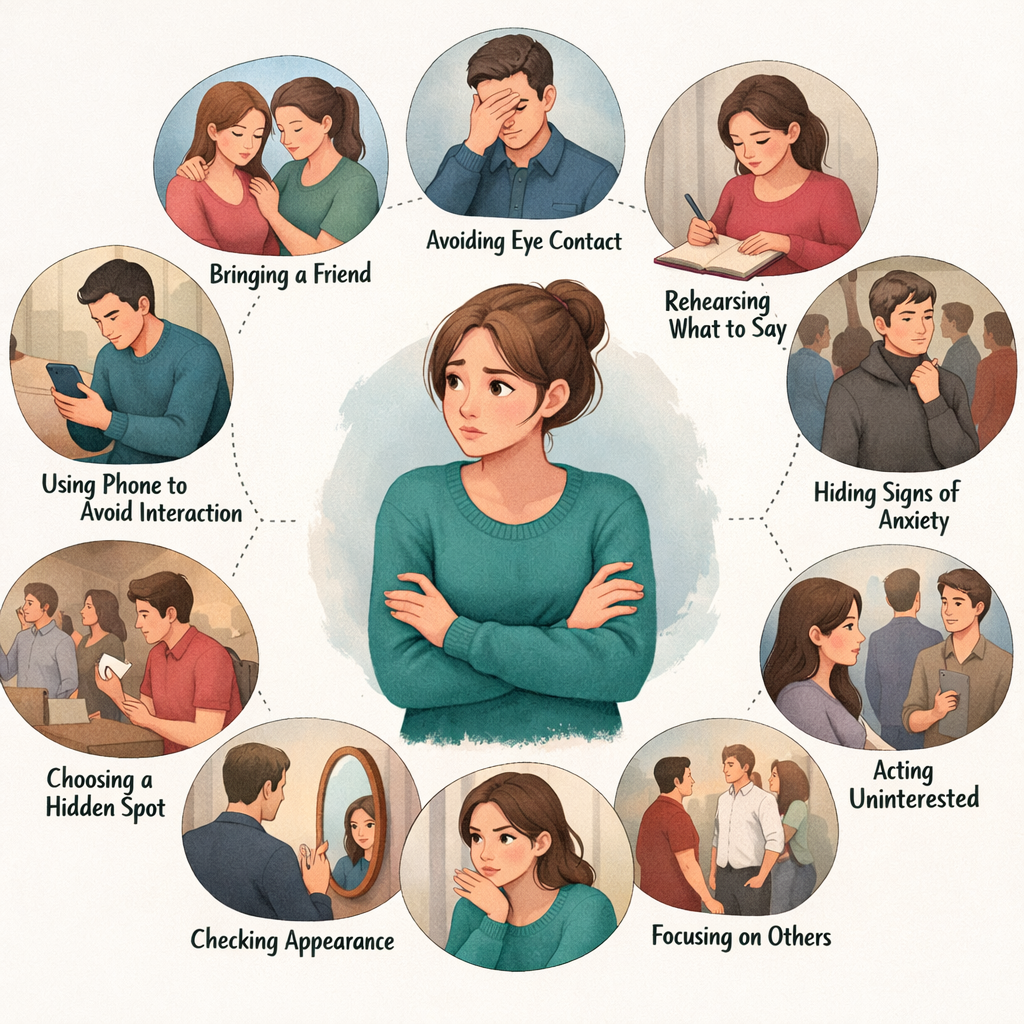
In addition to avoidance, many people with social anxiety rely on safety behaviours to cope with feared situations. These are strategies used to reduce anxiety, prevent embarrassment, or minimize the chance of negative evaluation.
Unlike avoidance, safety behaviours allow someone to remain in a situation, but in a controlled or protective way. For example, a person may stay quiet, avoid eye contact, or mentally rehearse what to say.
Although these strategies can reduce anxiety in the short term, they often have unintended long-term effects. Because the person attributes their “success” to the safety behaviour rather than to their actual ability to cope, the underlying fear remains unchanged.
Common safety behaviours include:
- Bringing a friend for reassurance
- Avoiding eye contact
- Staying quiet or speaking as little as possible
- Rehearsing conversations in advance
- Focusing attention on others to avoid being noticed
- Using a phone to avoid interaction
- Choosing positions that attract less attention
- Wearing clothing to hide signs of anxiety (e.g., blushing)
- Checking appearance repeatedly
- Pretending to be uninterested or distant
Both avoidance and safety behaviours prevent new learning. In evidence-based treatments such as cognitive behavioral therapy (CBT), reducing these behaviours is an important step in breaking the cycle of social anxiety
Do these social anxiety symptoms sound familiar?
If you recognize these patterns in yourself, you are not alone. Social anxiety is common and highly treatable with the right approach.
A structured assessment can help clarify what is maintaining your anxiety and which treatment approach is most effective for your situation.
You can start with a test or reach out directly, whatever feels most comfortable.
Frequently asked questions about social anxiety symptoms
What are the main symptoms of social anxiety?
The main symptoms include fear of being judged, avoidance of social situations, physical symptoms like sweating or blushing, and negative self-focused thinking.
Are physical symptoms part of social anxiety?
Yes. Common physical symptoms include a racing heart, sweating, trembling, dizziness, and blushing.
Can you have social anxiety without avoiding situations?
Yes. Some people endure social situations with intense distress rather than avoiding them.
What are safety behaviours?
Safety behaviours are actions used to reduce anxiety, such as avoiding eye contact or staying quiet, but they often maintain the anxiety over time.