


Living with someone with borderline personality disorder
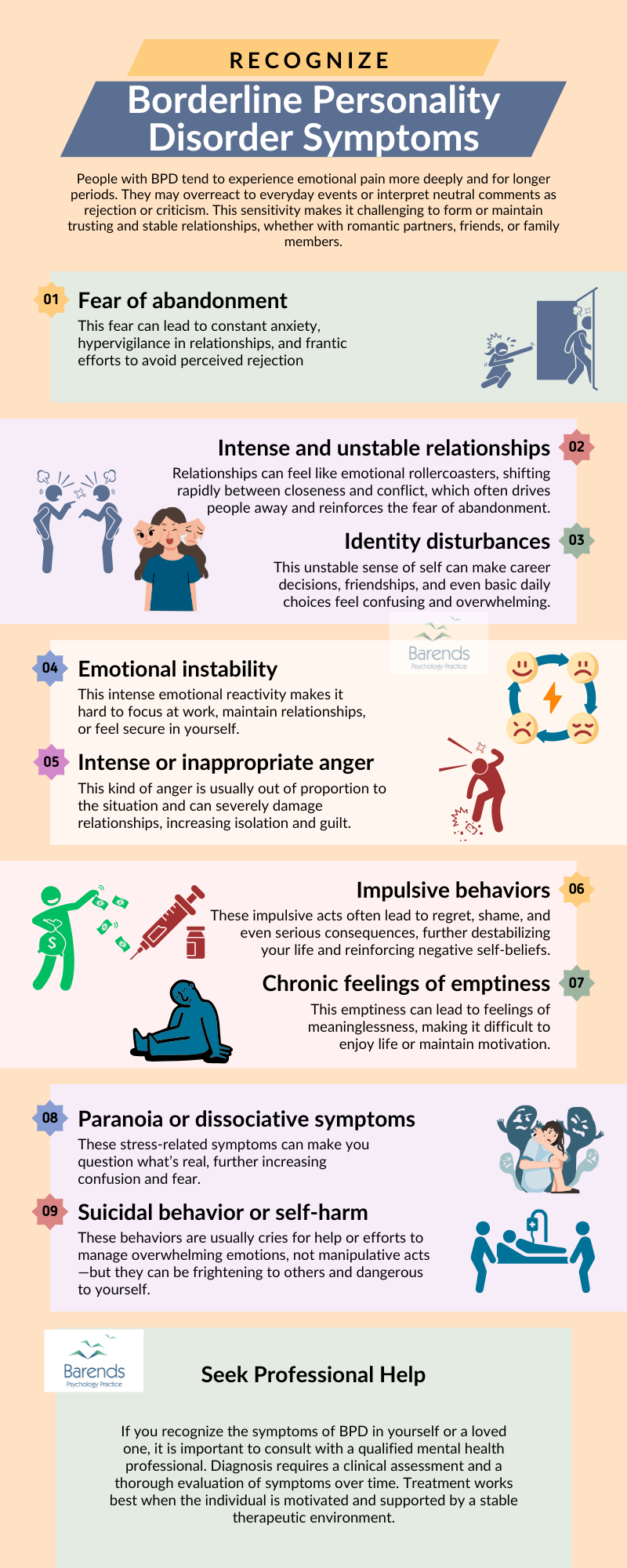
Borderline personality disorder facts.
Niels Barends, MSc
Psychologist with more than 11 years of clinical experience treating trauma, personality disorders, and complex relationship dynamics.
Specialized in Schema Therapy, Cognitive Behavioural Therapy (CBT), and EMDR.
Founder of Barends Psychology.
Last reviewed: March 2026
Borderline personality disorder (BPD) not only affects the person with BPD, but also the people around them. Individuals with BPD often struggle to regulate their emotions and behaviour, which can create significant challenges within relationships. Fortunately, living with someone with borderline personality disorder does not have to mean constant conflict or emotional exhaustion. By setting healthy boundaries, improving communication, and maintaining a stable relationship structure, partners and family members can create an environment that supports emotional regulation and healthier interactions.
The strategies on this page are designed to help you navigate these relationship dynamics more effectively. With patience, practice, and mutual understanding, living with someone with borderline personality disorder can become more manageable and less emotionally draining. Like any relationship skill, progress takes time, and both partners will inevitably make mistakes along the way.
This article provides educational information about supporting someone with borderline personality disorder (BPD). It is not intended as a substitute for professional diagnosis or treatment. If you or your partner experience severe emotional distress, self-harm, or relationship crises, please seek support from a qualified mental health professional.
Want to know which 3 treatments are effective for BPD?
Borderline Personality Disorder Guide:
- What is borderline personality disorder?
- BPD symptoms explained
- What causes borderline personality disorder?
- How is borderline diagnosed?
- Borderline personality disorder treatment
- Borderline personality disorder self-test
- Coping with borderline personality disorder
- Interesting borderline personality disorder facts
- Online counseling for borderline personality disorder
- Take me to the homepage
Why Supporting Someone With BPD Requires Different Approaches
People with BPD share core symptoms, but partners often notice very different stress reactions and relationship patterns. Personality structure influences what triggers escalation, what leads to withdrawal, and what helps restore stability.
While these differences are not diagnostic categories, they illustrate how people can respond to stress in distinct ways. Recognizing these patterns can help partners adjust their communication, boundaries, and support strategies more effectively.
The 20–80 Method describes five Archetypes that illustrate different stress-response patterns. This framework is not a diagnostic tool, but it can help partners reduce misinterpretations and choose support strategies that fit the person in front of them.
Visionary
A Visionary may escalate when meaning or future certainty feels threatened. Support is often most effective when it restores perspective rather than arguing about details.
Strategist
A Strategist may spiral into self-criticism and mental overdrive after conflict. Support tends to work best when it lowers decision load and reduces cognitive pressure.
Architect
An Architect may respond to stress by withdrawing or dissociating. Support is most effective when it is steady and low-pressure, without demanding immediate emotional processing.
Operator
An Operator may react quickly and intensely in moments of perceived rejection. Support is most helpful when it slows escalation early and protects recovery time afterward.
Connector
A Connector may experience strong attachment anxiety and heightened sensitivity to relational distance. Support works best when boundaries are clear and reassurance is consistent rather than reactive.
Understanding these differences can make boundaries and communication strategies more effective, which is exactly what the sections below focus on.
Professional Perspective on Supporting Someone With BPD
In clinical practice, partners and family members often experience significant emotional strain when living with someone who has borderline personality disorder. The intense emotional fluctuations, fear of abandonment, and impulsive reactions associated with BPD can create recurring misunderstandings and conflict within relationships. In some cases, prolonged exposure to severe relational stress can become psychologically overwhelming or even contribute to symptoms associated with complex trauma (C-PTSD).
Research shows that structured therapies such as Dialectical Behaviour Therapy (DBT), Mentalization-Based Therapy (MBT), and Schema Therapy can significantly improve emotional regulation and relationship stability. You can read more about these approaches on the page about borderline personality disorder treatment. While partners cannot “fix” BPD, learning how to set clear boundaries, communicate calmly, and maintain their own psychological well-being can make relationships significantly more stable.
Living with someone with borderline personality disorder – setting healthy boundaries
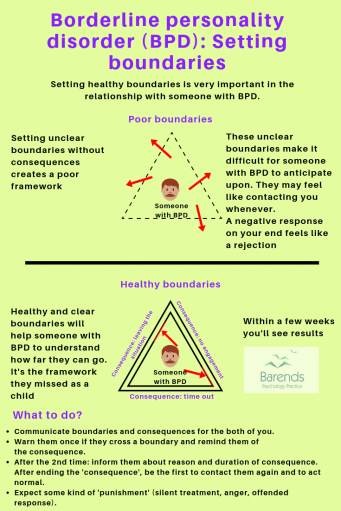 Healthy boundaries exist everywhere in society: at school, at work, on the road, and in public spaces. These rules and expectations help people understand how to behave and prevent confusion, frustration, or conflict.
Healthy boundaries are especially important when living with someone with borderline personality disorder, because they make behaviour and expectations more predictable within the relationship. Clear boundaries reduce misunderstandings and can help someone with BPD feel more stable and secure.
For example: if one of your boundaries is: “no contact during working hours”, then it will be easier for someone with BPD to accept that you won’t pick up the phone if he or she calls you. If you don’t have this healthy boundary, then someone with BPD may start to worry that you don’t want to pick up the phone if he/she calls you (fear of rejection/abandonment), whereas you may be in a meeting at that time.
Although setting boundaries can be quite challenging, in the end, they will help build a sense of trust and respect between the two of you.
Setting healthy boundaries can be challenging because people with BPD may interpret setting boundaries as a sign of rejection (which is something they fear the most). A possible response may be that the one with BPD reacts out of proportion to the newly set boundaries (with rage, anger or abuse). By giving in to avoid conflict, you may unintentionally reinforce the behaviour, which can create a repeating negative pattern within the relationship. Therefore it’s important to stick to the new healthy boundaries and respond the way you agreed upon. Here are several practical steps that can help you introduce and maintain healthy boundaries in the relationship:
- Introduce boundaries when the two of you are calm: Introducing boundaries won’t work when you two are emotional or in a fight. Wait until you are calm before you introduce healthy boundaries. Don’t introduce them all at once, because that can be quite overwhelming. By introducing boundaries gradually you give each other time to get used to the new boundary before moving to the next one. Make sure both of you agree with the new boundaries.
- Explain why you think boundaries are needed: It’s important to explain why you are introducing boundaries, because people with BPD may interpret it as a sign of rejection. A wrong way to do this is by blaming someone: ‘your behaviour causes us to fight all the time’. This will most likely come across as offensive and is counter-effective. Instead, try this method: ‘Every time we get into a fight I feel exhausted, sad and frustrated. I can imagine you feel the same way. I don’t like this feeling, so I want to change things to improve our relationship and to reduce the amount of fights we have’. This way you expose yourself (you are being vulnerable) and explain that these boundaries are not introduced because of the person with BPD. At the same time it’s clear for the person with BPD that you don’t reject him or her.
- The boundaries should work both ways: If you set healthy boundaries, but you can’t stick to them yourself it’s very unlikely that someone with BPD will stick to them. Therefore it’s important to set boundaries as follows: “From now on, whenever we have a discussion we will not curse or use threats, because they do not add to the discussion. Whenever someone curses or uses threats the discussion is over. We may then continue when we are both calmed down. If one of us continues to curse or use threats, then the other person can walk away from the discussion”.
(Advertisement. For more information, please scroll down.)
- Enforce the consequences: If consequences are not enforced, boundaries lose their meaning and the behaviour will likely continue. Therefore, it’s important to introduce consequences you can realistically follow through on. Be aware that those consequences should be a last resort. Someone with BPD will cross (by accident or deliberately) your boundaries a few times and it may be difficult to be strict, because you love your partner/friend/relative, but it’s for the best.
An example for a consequence could be: “If one of us continues to use ultimatums or continues to be verbally abusive, the other person should call a one-week time-out with no contact.” In this example you can see that negative behaviour needs to continue for a while (you can set a limit of course) after which the consequence will be enforced. - Don’t tolerate abusive behaviour: Abusive behaviour: physical, verbal, and non-verbal are simply not healthy in a relationship and shouldn’t be accepted at all. The fact that your partner/friend/relative has a personality disorder doesn’t mean he or she can abuse you in any way. Your own safety is more important than someone else’s abusive behaviour. If the behaviour continues and cannot be addressed safely, it may be necessary to reconsider the relationship.
Side note: potential risks of using ChatGPT for emotional support
When your partner lives with BPD, emotional regulation and interpersonal boundaries are often fragile. If they turn to ChatGPT for self-help or emotional support, the bot’s constant affirmation and lack of realistic boundaries may create a false sense of emotional security or even a pseudo-relationship dynamic. This can lead to emotional triangulation, where the bot seems more “understanding” than you are, eroding trust and intimacy. Worse, the idealization of the chatbot can mirror relationship cycles of splitting—intensifying emotional instability and distancing the person from real-world coping strategies and healthy communication with you. For more information, please read our informative article on the risks of chatGPT on mental health.
Living with someone with borderline personality disorder – improving communication
Communication is important in every relationship. Communication with someone with borderline personality disorder (BPD), however, is often the most important ingredient for a successful relationship. Understanding how people with BPD learn to regulate emotions themselves can also help partners navigate conflict. You can read more about this on the page about coping with borderline personality disorder. People with BPD have difficulty regulating their emotions and behaviour, which can cause a lot of problems for those around them. These emotional patterns are described in more detail on the page about borderline personality disorder symptoms. This means that you need to be very clear about your intentions, thoughts, and emotions, and try to leave as little room as possible for their own interpretation of events. Below are a few tips and tricks that will improve your communication with someone with borderline personality disorder. For more general communication tips, please go to: communication in relationships.
- Focus on emotions, not on words: unlike in a normal relationship, communicating with someone with BPD means you have to focus more on their emotions than on their words. When they are emotional they may say things that make little sense (it’s difficult for everyone to stay rational when they are emotional). Therefore, it can be very confusing to listen to their story. In some cases it could upset you which could lead to an altercation or fight. And that’s what you want to avoid, so I recommend you to focus on their emotions and try to calm them down. The moment you realize your approach isn’t working, it may be better to leave the situation until the both of you are calmed down. Remember to explain this to your partner.
- Try to stay calm: your partner needs someone who remains calm, even when he/she is very emotional and unreasonable. By staying calm, someone with BPD calms down more easily as well. Of course, this is easier said than done. In case you notice you’re getting upset or angry as well, it’s better to leave the situation rather than continuing with the discussion. Please make sure you partner knows you will leave when you get upset.
- Listen actively and be sympathetic: Someone with BPD often feels like no-one is listening to them. This can be extremely frustrating to them. Therefore, it’s important for you to listen to them and make them feel heard. That means: do not interrupt them (unless they become abusive), focus on them (not on the computer, cell phone or television), withhold blame and criticism, and try to redirect the conversation to the initial point in a calm way. This way it’s more likely that their emotions won’t rise.
- Use distraction as a strategy: It’s difficult for people to think rationally when they are very emotional. The moment people calm down they can think more clearly. Therefore, it’s important to distract someone who is high in their emotions by bringing up different topics or by doing something with that person. Ask your partner which activities sooth her and use them whenever you feel your partner needs them. A few examples include: going for a hike, listening to music, doing household chores, painting or drawing, cooking or baking something, or playing with a pet.
- Focus on the good things in the relationship: A relationship is much more than just your partner’s mental disorder. In fact, their borderline personality disorder is just a part of your relationship. There are probably a lot of shared interests. Talk about these things, talk about the things that make you happy. This could be used as a strategy after a tough discussion or argument: you partner will most likely calm down already.
Living with someone with borderline personality disorder means you have to be aware of the way you communicate, the things you do to calm down your partner and to focus on the good things in the relationship. It’s a constant effort that will pay off in the end. Patience and persistence is key to make a relationship with someone with BPD successful.
(Advertisement. For more information, please scroll down.)
Living with someone with borderline personality disorder – putting things in perspective
Playing “Borderline Bingo” can be a helpful mental tool for people living with someone who has Borderline Personality Disorder (BPD). By mentally checking off recognizable patterns — like emotional baiting, black-and-white thinking, or sudden shifts from idealization to devaluation — you start to see these behaviors not as personal attacks, but as symptoms of a deeper psychological struggle. It creates emotional distance: instead of feeling hurt, confused, or responsible, you begin to notice, “Ah, there’s another pattern.” This simple shift in perspective can reduce emotional reactivity, foster more compassion, and help you maintain your boundaries while navigating a challenging relationship dynamic.
How does Borderline Bingo work?
Living with someone with borderline personality disorder can be very different from living with someone who does not struggle with a personality disorder. As mentioned in the pages on this website dedicated to borderline personality disorder (BPD), people with BPD have a fear of (potential) abandonment/rejection and experience difficulty regulating their emotions. Therefore, I recommend you to put the relationship in perspective. Can you expect the same from someone with BPD as from someone without? Is it reasonable to assume that your BPD partner understands your motives and behaviour as well as others do? These are just a few questions that may help you to put your relationship with someone with BPD in perspective. Here are a few things you need to take into consideration:
- Giving your opinion: giving your opinion on a delicate topic may backfire eventually. A delicate topic could be: looks, appearance, opinions on certain political situations, skills someone has or lacks, having an argument with someone, and so on. Example: your partner with BPD has an argument with someone else and asks for your opinion on this matter. If you disagree with your partner with BPD, he or she may perceive it as a rejection. This may lead to insecurity and an argument. If you agree with your partner, they may start involving you in the conflict, which can quickly become uncomfortable.
A better strategy would be to stay neutral and to highlight possible explanations, arguments, and how their emotions may affect their judgment. This way someone with BPD will not feel rejected by you. At the same time your partner with BPD will get more insight in the way his/her feelings and emotions could affect her judgment regarding the situation. - Assumptions and clarity: people with BPD have difficulty reading non-verbal behaviour, and even more importantly whenever they lack information they start assuming things. Living with someone with borderline personality disorder means you have to be very clear when it comes to communication. Don’t assume your partner reads your body language well, don’t assume your partner will understand the fact that you are three hours late (without notifying him/her), and so on. Instead, be clear about your feelings and emotions when you and your partner are communicating and notify your partner in time when you expect to be delayed. Also when it comes to arguments: let your partner know how his/her actions make you feel at certain moments, and explain why you want to/will leave the situation when things get out of hand. Another important point to keep in mind: don’t assume that arguments will blow over. For you they may, but for someone with BPD this leaves open a lot of questions, feelings, and emotions and that could lead to false assumptions from her side.
- Take care of yourself: a relationship with someone with borderline personality disorder can be exhausting and emotionally demanding, and at times it may feel unrewarding. That’s why it’s important to make sure you have a life of your own and you have fun. It’s not selfish to go out, exercise or meet with friends without your partner. In fact, it will make you feel better about yourself and gives you new energy. Don’t forget to maintain regular sleep and eating patterns. Especially when the relationship is very turbulent it’s easy for people to forget about their healthy habits… please, don’t! It will make you feel worse about yourself if you forget about them.
Living with someone with borderline personality disorder isn’t like any other relationship. These relationships require more attention and effort than the average relationship. On the other hand, a relationship with someone with BPD can be very rewarding and a lot of fun, if you apply the above mentioned steps. If you are struggling in a relationship affected by borderline personality disorder, professional guidance can help you understand the patterns and protect your own well-being. You can contact us here if you would like to discuss your situation.