


Generalized anxiety disorder symptoms
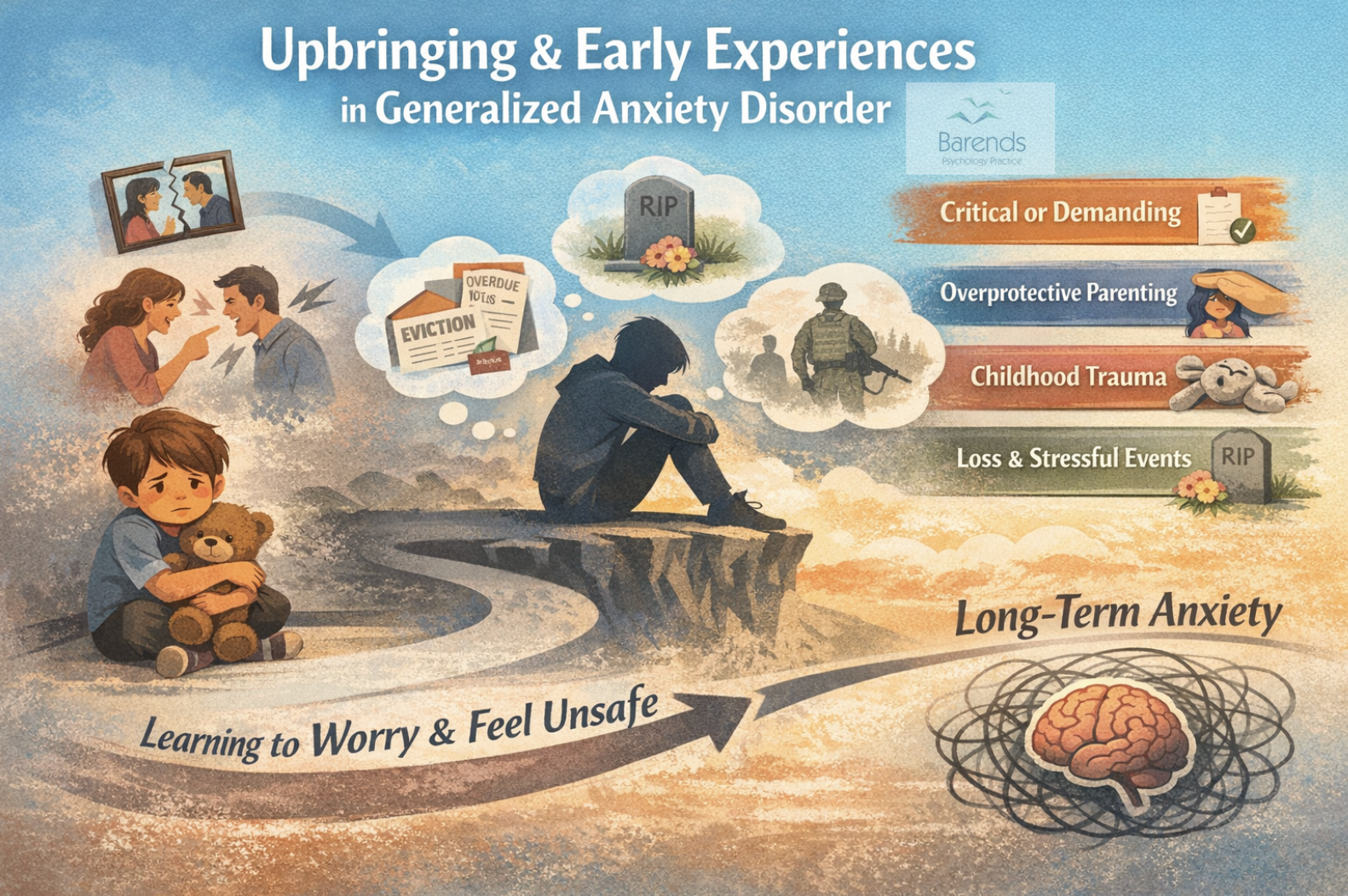
Worrying is a normal part of life. It helps you anticipate challenges, prepare for important situations, and make decisions. In most cases, worry is temporary and linked to specific problems that can be addressed.
For individuals with generalized anxiety disorder (GAD), however, worry becomes persistent, excessive, and difficult to control. Instead of helping to solve problems, it turns into an ongoing mental process that creates tension and keeps the mind focused on potential risks, even when there is no immediate reason for concern.
What makes GAD different is not just the intensity of the worry, but the pattern behind it. Thoughts tend to move continuously from one topic to another, often driven by “what if” scenarios and a need for certainty. This can create a constant sense of mental activity, making it difficult to relax, concentrate, or feel at ease.
Over time, this ongoing state of anticipation affects both psychological and physical functioning. Many people experience fatigue, irritability, sleep problems, and muscle tension, even when their daily life appears relatively stable from the outside.
Because these symptoms often revolve around everyday concerns such as work, health, or relationships, they are not always immediately recognized as part of a broader anxiety pattern. You can read more about this on the generalized anxiety disorder overview page.
This page provides a structured overview of the most common generalized anxiety disorder symptoms, how they present in daily life, and when it may be helpful to seek professional support.
Quick facts about GAD symptoms
- GAD involves persistent and excessive worry about multiple areas of life
- The worry is often difficult to control and feels automatic
- Common symptoms include restlessness, fatigue, concentration problems, and sleep issues
- Many people experience physical symptoms such as muscle tension, headaches, or gastrointestinal discomfort
- Worry often shifts between topics, creating a continuous stream of thoughts
- Symptoms typically develop gradually and can go unrecognized for years
- Effective treatment focuses on reducing worry patterns and improving tolerance of uncertainty
Do you recognize these symptoms of generalized anxiety disorder?
Persistent worry, overthinking, and difficulty relaxing can be exhausting. Professional guidance can help you understand these patterns and learn how to reduce anxiety effectively.
Schedule a free initial consultation
You can also take a generalized anxiety disorder test for a first indication of your symptoms.
Jump to
Do I have generalized anxiety disorder?
Many people who experience symptoms of generalized anxiety disorder (GAD) do not immediately recognize it as a specific condition. Instead, they often describe themselves as “overthinkers”, “someone who worries a lot,” or someone who finds it difficult to switch off their thoughts.
The difference between normal worrying and GAD is not always obvious. In GAD, worry tends to be persistent, difficult to control, and present across multiple areas of life, even when there is no immediate problem that requires attention.
You may recognize patterns such as:
- Feeling like your mind is constantly active, moving from one concern to another
- Difficulty switching off or relaxing, even in calm situations
- Frequently thinking through “what if” scenarios or worst-case outcomes
- Going over conversations or decisions repeatedly, trying to make sure you didn’t make a mistake
- Feeling mentally exhausted, even when your day was not objectively demanding
- Struggling with uncertainty or indecisiveness
These patterns often develop gradually and can feel like a normal part of your personality over time. However, when worry becomes chronic, intrusive, and difficult to manage, it may indicate an underlying anxiety pattern rather than just a temporary response to stress.
Professional insight:
In therapy, people rarely come in saying they have generalized anxiety disorder. More often, they describe feeling like they “think too much,” can’t stop going over things in their mind, or feel mentally exhausted from constant analysis. Many only realize later that this pattern of persistent worrying is not just a habit, but something that is maintaining their anxiety over time.
Niels Barends, MSc
Psychologist specialized in anxiety and psychological patterns
If you recognize several of these patterns, it can be helpful to explore this further. A structured screening tool, such as a generalized anxiety disorder test, can provide a first indication of whether your symptoms are consistent with GAD.
Keep in mind that an online test does not replace a professional diagnosis. If your symptoms persist or interfere with your daily functioning, it may be useful to seek guidance from a qualified professional.
Core symptoms of generalized anxiety disorder (DSM-5-TR)
According to the DSM-5-TR, generalized anxiety disorder (GAD) is characterized by excessive anxiety and worry occurring more days than not for at least six months, about a range of everyday topics such as work, health, or relationships.
In addition, the worry must be difficult to control and associated with several psychological and physical symptoms. Below is an overview of the core symptoms, including how they are often described in practice.
1. Excessive anxiety and worry
The worry is persistent, broad, and not limited to one specific situation. It often shifts from one topic to another, creating a continuous stream of concerns.
In practice, people often say:
- “I always find something to worry about, even when things are going well.”
- “As soon as one problem is solved, the next one shows up.”
- “My mind just keeps going.”
2. Difficulty controlling the worry
People with GAD often feel that their worry is automatic and hard to stop, even when they recognize it is not helpful.
In practice:
- “I try to stop thinking about it, but I can’t.”
- “Even when I distract myself, the thoughts come back.”
- “It feels like my brain doesn’t have an off switch.”
3. Restlessness or feeling “on edge”
A constant sense of internal tension or alertness is common. Many people describe feeling unable to fully relax.
In practice:
- “I feel tense, even when nothing is happening.”
- “It’s hard to just sit and do nothing.”
- “I always feel like something is about to go wrong.”
4. Being easily fatigued
The constant mental activity can be exhausting, even without significant physical effort.
In practice:
- “I feel tired all the time, even after sleeping.”
- “My mind never really rests.”
- “It feels like I’m mentally drained by the end of the day.”
5. Difficulty concentrating or mind going blank
Persistent worry interferes with attention and focus, making it harder to stay engaged in tasks.
In practice:
- “I read something and immediately forget it.”
- “I keep drifting off into my thoughts.”
- “It’s hard to focus because I’m always thinking about something else.”
6. Irritability
Ongoing tension can lower tolerance for stress, leading to increased irritability or frustration.
In practice:
- “Small things annoy me more than they used to.”
- “I feel on edge with people.”
- “I react more quickly than I want to.”
7. Muscle tension
Physical tension is a common but often overlooked symptom, especially in the neck, shoulders, or jaw.
In practice:
- “My shoulders are always tight.”
- “I notice I’m clenching my jaw without realizing it.”
- “I feel physically tense most of the day.”
8. Sleep disturbances
Worry often interferes with sleep, either by making it difficult to fall asleep or by causing restless, non-restorative sleep.
In practice:
- “My mind starts racing as soon as I go to bed.”
- “I wake up in the middle of the night thinking about things.”
- “Even when I sleep, I don’t feel rested.”
To meet the criteria for generalized anxiety disorder, several of these symptoms need to be present consistently over time and cause noticeable distress or impairment in daily functioning.
If you recognize these patterns, it may be helpful to explore them further using a
generalized anxiety disorder test or by reading more about treatment options for GAD.
Do these symptoms sound familiar?
If you recognize patterns such as constant worrying, difficulty switching off your thoughts, or feeling mentally tense most of the time, it can be helpful to explore this further.
You can take a short generalized anxiety disorder (GAD) test to get a first indication of your symptoms and whether they may be consistent with GAD.
The test provides an indication, not a diagnosis. For a full assessment, professional evaluation is recommended.
How generalized anxiety disorder symptoms show up in daily life
Generalized anxiety disorder (GAD) is not only about feeling anxious. In daily life, it often presents as a persistent mental process that influences how you think, make decisions, interact with others, and experience even neutral situations.
Because the symptoms are woven into everyday thoughts and behaviors, many people do not immediately recognize them as anxiety. Instead, they experience them as part of their personality or way of thinking.
Constant mental activity
One of the most noticeable patterns is a continuous stream of thoughts. The mind moves from one topic to another, often anticipating potential problems or trying to prevent negative outcomes.
This can happen during routine activities such as commuting, working, or even relaxing. Moments that would normally feel neutral are filled with analysis, planning, or “what if” thinking.
Difficulty making decisions
Even relatively small decisions can feel disproportionately difficult. This is not due to a lack of ability, but because each option is mentally explored in detail, including possible risks and consequences.
As a result, decision-making can become time-consuming, mentally exhausting, and associated with doubt, even after a choice has been made.
Replaying and analyzing situations
After conversations or events, many people with GAD find themselves mentally reviewing what happened. They may go over what they said, how others responded, and whether they made a mistake.
This process is often driven by a need for certainty or reassurance, but rarely leads to a clear resolution. Instead, it tends to prolong mental engagement and increase self-doubt.
Difficulty relaxing
Relaxation is often experienced as uncomfortable or unfamiliar. When there is no immediate task or distraction, the mind tends to return to worrying.
This can make activities such as watching a movie, going to bed, or taking time off feel less restorative, because mental activity continues in the background.
Physical tension throughout the day
Many people are not immediately aware of how much physical tension they carry. This can show up as tight shoulders, jaw clenching, headaches, or a general sense of restlessness.
Because this tension builds gradually, it often becomes the “new normal” rather than something that stands out.
Sleep affected by ongoing thinking
Sleep is often disrupted, not necessarily because of external stress, but because the mind becomes more active when there are fewer distractions.
People may have difficulty falling asleep, wake up during the night, or feel that their sleep is not fully restorative due to ongoing mental activity.
Clinical insight:
In therapy, people with generalized anxiety disorder often describe their experience not as “feeling anxious,” but as being unable to switch off their thinking. They may say they are constantly going over things, preparing for situations, or trying to prevent problems. Over time, this creates a state where the mind is always active, even when there is no immediate reason to be concerned. Understanding this pattern is often a key step in reducing anxiety.
Niels Barends, MSc
Psychologist specialized in anxiety and psychological patterns
What makes these symptoms particularly challenging is that they are often internally driven. From the outside, someone may appear calm, functional, and in control, while internally experiencing continuous tension and mental activity.
If you recognize these patterns, it may be helpful to explore whether they are part of a broader anxiety pattern. You can take a
generalized anxiety disorder test or read more about
how GAD can be treated.
When should you seek help for generalized anxiety disorder?
Not all worry requires professional support. However, it can be helpful to seek guidance when anxiety becomes persistent, difficult to control, and starts to affect your daily functioning or well-being.
Because generalized anxiety disorder (GAD) often develops gradually, many people adapt to their symptoms over time. What initially feels like a temporary response to stress can become a chronic pattern of thinking and reacting that is harder to recognize from the inside.
Signs it may be time to seek support
- You feel mentally exhausted from constant worrying or overthinking
- You have difficulty switching off your thoughts, even during rest or at night
- Your anxiety affects your concentration, sleep, or energy levels
- You avoid situations or decisions because they feel overwhelming
- You notice that worry is increasing rather than decreasing over time
When anxiety starts affecting your relationships
An often overlooked aspect of GAD is how it influences relationships and social interactions. Because worry is internally focused, its impact on relationships may be subtle but persistent.
For example, you may:
- Seek reassurance from others to reduce uncertainty
- Overanalyze conversations or interactions afterward
- Worry about how you are perceived or whether you said something wrong
- Feel responsible for preventing problems or conflict in relationships
- Become mentally preoccupied, making it harder to be fully present
Over time, these patterns can create tension, misunderstanding, or emotional distance, even when your intention is to maintain connection or avoid problems.
Relational patterns and underlying dynamics
In practice, anxiety is often connected to deeper relational patterns. These patterns influence how you interpret situations, respond to uncertainty, and relate to others.
For example, some people tend to take on a responsible or controlling role in relationships, trying to anticipate and prevent potential issues. Others may become more self-critical or approval-focused, aiming to avoid rejection or conflict. These patterns can increase sensitivity to uncertainty and reinforce worry.
You can read more about these recurring patterns on the
relational archetypes page, where different ways of relating to others are explained in more detail.
Understanding these dynamics is often an important part of treatment. It helps clarify why certain situations trigger anxiety more strongly and how these reactions are maintained over time.
Clinical insight:
In therapy, people often seek help when they notice that worrying is not only affecting how they feel, but also how they relate to others. They may find themselves overthinking conversations, needing reassurance, or feeling responsible for preventing problems in relationships. Exploring these patterns often provides important insight into how anxiety is maintained and how it can be reduced.
Niels Barends, MSc
Psychologist specialized in anxiety and psychological patterns
If your symptoms persist, increase over time, or start affecting your relationships, work, or well-being, it may be helpful to seek professional support. Treatment focuses not only on reducing symptoms, but also on understanding the underlying patterns that maintain anxiety.
You can take a generalized anxiety disorder test
for a first indication, or explore treatment options for GAD.

Frequently asked questions about generalized anxiety disorder symptoms
What are the main symptoms of generalized anxiety disorder?
The main symptoms of generalized anxiety disorder include excessive worry, difficulty controlling the worry, restlessness, fatigue, difficulty concentrating, irritability, muscle tension, and sleep problems.
How do I know if my worry is too much?
Worry may be excessive when it feels difficult to control, occurs frequently across different areas of life, and affects your sleep, concentration, relationships, or overall well-being.
Can generalized anxiety disorder cause physical symptoms?
Yes. Generalized anxiety disorder often includes physical symptoms such as muscle tension, headaches, restlessness, gastrointestinal discomfort, fatigue, and sleep disturbances.
Do GAD symptoms always feel like anxiety?
Not necessarily. Many people experience GAD more as constant thinking, overanalyzing, mental tension, or an inability to switch off, rather than as obvious panic or fear.
Can GAD symptoms come and go?
Yes. Symptoms can fluctuate depending on stress levels and life circumstances. However, the underlying pattern of excessive worry often remains present over time.
Can generalized anxiety disorder affect relationships?
Yes. GAD can affect relationships through reassurance-seeking, overthinking conversations, difficulty relaxing, irritability, or feeling responsible for preventing problems. Over time, this can create tension or emotional distance.
When should I seek help for GAD symptoms?
It may be helpful to seek support when worry feels persistent, difficult to control, or starts to interfere with your daily functioning, sleep, work, or relationships.
What should I do if I recognize these symptoms?
A good first step is to take a generalized anxiety disorder test. If symptoms persist or significantly affect your life, professional support can help clarify what is going on and what treatment may help.