


Borderline personality disorder symptoms: complete overview
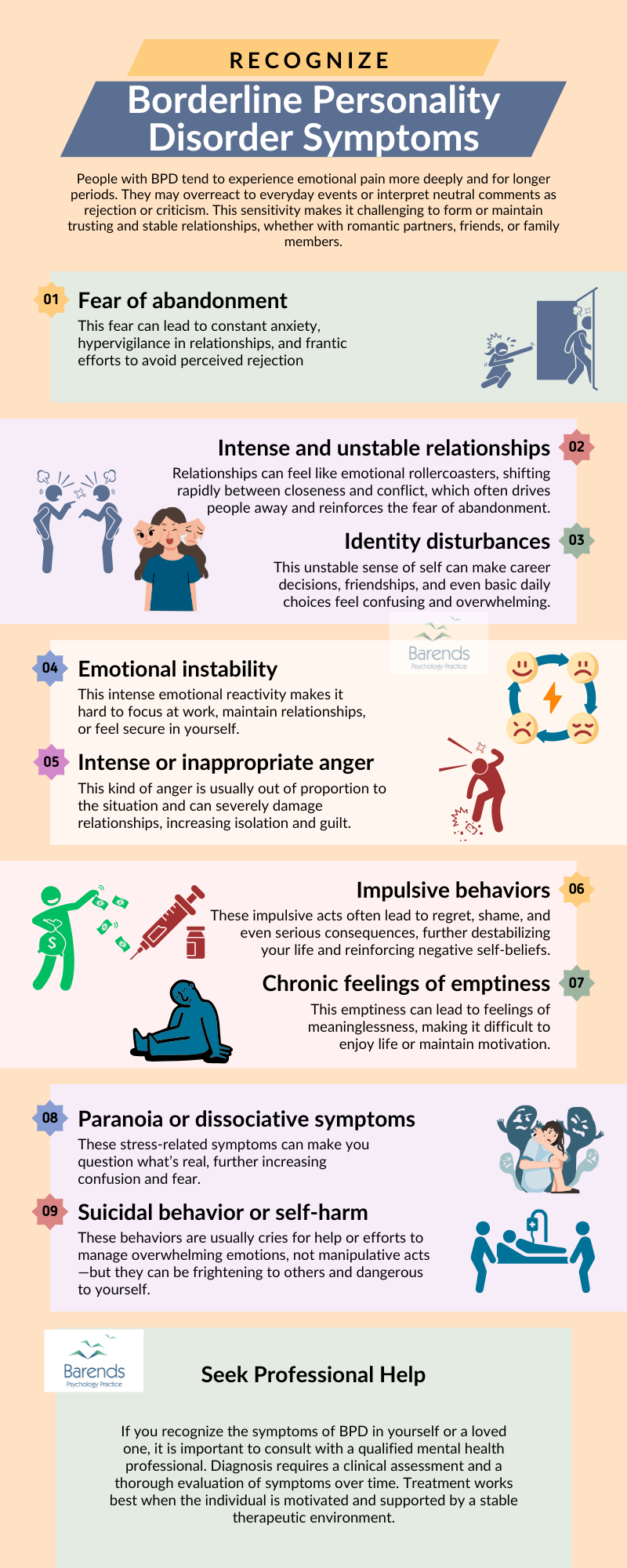

Borderline personality disorder (BPD) symptoms include emotional instability, intense fear of abandonment, impulsive behaviour, unstable relationships, and a fluctuating sense of self. These symptoms can feel overwhelming and often lead to difficulties in daily functioning and relationships.
According to the DSM-5-TR, BPD is defined as a persistent pattern of instability in emotions and interpersonal relationships, combined with marked impulsivity. These patterns typically begin in early adulthood and occur across multiple situations.
In the ICD-11, borderline personality disorder is described as a “borderline pattern” within a broader personality disorder diagnosis, with additional focus on severity and personality traits. You can read more about how this works on our BPD diagnosis page.
Because many symptoms overlap with other conditions, such as complex PTSD, anxiety disorders, or PTSD, it is important to understand the full pattern rather than focusing on individual symptoms.
On this page, you will find a clear and structured overview of BPD symptoms and how they relate to diagnosis and treatment. If you are unsure whether these symptoms apply to you, you can also take the BPD test or explore treatment options.
— Niels Barends, MSc, psychologist

Written by:
Niels Barends, MSc
Psychologist & founder of Barends Psychology Practice
14+ years of clinical experience treating trauma, borderline personality disorder, and complex relationship dynamics.
Specialised in Schema Therapy, CBT, and EMDR.
Reviewed against DSM-5-TR & ICD-11 | Last updated: February 2026
Key facts about borderline personality disorder symptoms
- BPD symptoms include emotional instability and fear of abandonment.
- Symptoms often begin in early adulthood and affect multiple areas of life.
- BPD is associated with difficulties in relationships and emotional regulation.
- Symptoms can overlap with PTSD and anxiety disorders.
- Effective treatments such as DBT and Schema Therapy can significantly reduce symptoms.
Navigate borderline personality disorder:
-
Understand BPD symptoms
Borderline personality disorder symptoms explained •
How BPD is diagnosed (DSM-5 & ICD-11) -
Causes and underlying patterns
What causes borderline personality disorder? -
Treatment and professional help
Evidence-based treatment for BPD • Start online therapy -
Self-help and coping
Coping with borderline personality disorder • Take the BPD test -
Relationships and daily life
Living with someone who has BPD -
Additional insights
Borderline personality disorder facts • Homepage
If you recognize several of these patterns in yourself or someone close to you,
early professional guidance can significantly improve stability and long-term outcomes.
Borderline Personality Disorder Symptoms Explained
DSM‑5‑TR Criteria for BPD (9 Criteria)
DSM‑5‑TR states that at least 5 of the following 9 criteria must be met:
- 1. Frantic efforts to avoid real or imagined abandonment
- 2. Unstable and intense relationships (idealizing–devaluing)
- 3. Identity disturbance (unstable self-image or sense of self)
- 4. Impulsivity in at least two self‑damaging areas
- 5. Recurrent suicidal/self‑harm behavior, gestures, or threats
- 6. Affective instability (reactive moods)
- 7. Chronic feelings of emptiness
- 8. Inappropriate, intense anger or inability to control it
- 9. Transient stress-related paranoid ideation or severe dissociation
Let’s break down each of the borderline personality disorder symptoms, with examples and life implications.
Frantic efforts to avoid abandonment
Description: This involves extreme reactions—even to imagined abandonment. These patterns are closely linked to fear of abandonment and can be intensified by earlier trauma-related experiences.
They may manifest as:
- Pleading, clinging, calling/texting multiple times a day
- Manipulative behaviors like self-harm threats to stop someone from leaving
Example & life impact: Maria broke up with her partner. Overwhelmed, she threatened to harm herself if he didn’t stay. While this prompted immediate crisis intervention, the relationship remained unstable. Her attempts to avoid abandonment often pushed partners away, reinforcing her fears.
Daily life impact: Leads to relationship exhaustion, social isolation, and frequent crisis encounters. Learning to recognize these patterns is an important step in
coping with borderline personality disorder and building more stable relationships.
— Niels Barends, MSc, psychologist at Barends Psychology Practice
Unstable and intense relationships
Description: Relationship patterns often shift between idealization and devaluation (also known as “splitting”). These dynamics are a core part of
borderline personality disorder symptoms and are often linked to fear of abandonment and emotional sensitivity.
Example & life impact: Tom idolizes his therapist, then abruptly reacts with anger and rejection when he feels misunderstood. This pattern can strain therapy, work relationships, and friendships, creating a cycle of intense attachment followed by conflict or withdrawal.
Daily life impact: Leads to interpersonal instability, frequent misunderstandings, and difficulty maintaining trust. These patterns are explored in more detail on the page about
living with someone who has borderline personality disorder.
Learning to recognize these cycles is an important step in
coping with BPD and building more stable relationships.
Identity disturbance
Description: A markedly unstable or fragmented self-image and sense of self. This is one of the core
borderline personality disorder symptoms and often affects values, goals, beliefs, and long-term direction.
Example & life impact: Lina shifts career paths, hobbies, and beliefs quickly: one day deeply religious, the next atheist. Her sense of self is so unstable that it interferes with long-term planning, emotional stability, and decision-making.
Daily life impact: Can lead to helplessness, dissociation or trauma-related symptoms, and unstable academic or professional development. Understanding these patterns is important for both
accurate diagnosis and effective treatment.
Recurrent suicidal/self-harm behavior
Description: Includes threats, gestures, self-harm, or suicidal actions.
Example & life impact: Emma cuts herself when feeling emotionally overwhelmed. Her family constantly monitors her, house is filled with trauma residue, and she frequently visits emergency services.
Daily life impact: Constant life threat, hospital visits, disrupted trust, decreased autonomy.
— Niels Barends, MSc, psychologist at Barends Psychology Practice
Affective instability
Description: Marked mood reactivity (dysphoria, irritability, anxiety) usually lasting hours, rarely days.
Example & life impact: Within hours, Markus switches from elation to despair. He quits his job impulsively and redeems himself days later with the same energy; his environment remains volatile.
Daily life impact: Challenges in work/relationships; unpredictability seen as unreliable or dramatic.
Chronic feelings of emptiness
Description: Persistent boredom, void, lack of meaning.
Example & life impact: Elaine feels nothing even in loving moments. To fill the void, she seeks risky stimuli (sexual, substance-driven) leading to unsafe encounters and intensified internal pain.
Daily life impact: Leads to identity confusion, poor self-care, dysfunctional coping strategies.
Intense anger or inability to control it
Description: Frequent temper, sarcasm, physical fights.
Example & life impact: When criticized, David reacts with fury: breaking objects, yelling at loved ones. He later apologizes profusely, but the damage is done: others avoid interacting with him.
Daily life impact: Creates fractured personal relationships and social isolation.
Transient stress-related paranoid ideation or dissociation
Description: Brief paranoia or dissociative episodes under stress.
Example & life impact: Anna feels someone’s out to harm her. She disconnects, spacing out during conversations. Although short-lived, these episodes erode her credibility, impair her concentration and trust in reality.
Daily life impact: Creates dangerous situations, interpersonal misunderstandings, and stigmatization.
ICD‑11: Severity + Borderline Personality Disorder Symptoms Pattern Specifier
Main difference: ICD‑11 no longer lists personality disorder types. Instead, it assesses:
- 1. Global severity: personality difficulties rated from mild to severe
- 2. Trait qualifiers: Negative affectivity, Detachment, Disinhibition, Dissociality, Anankastia
- 3. Optional Borderline Pattern specifier: Based on ≥5 of the DSM-5 criteria
Severity ratings
- Mild: Some dysfunction in self/interpersonal
- Moderate: Clear dysfunction, hard to develop stable relationships
- Severe: Significant dysfunction, may include transient psychotic-like experiences
Example: Ana scores moderate severity (global instability but intact reality testing). She qualifies for ICD‑11’s “moderate PD with Borderline Pattern.”
Borderline Personality Disorder Symptoms – Trait domains × BPD features
The Borderline Pattern often aligns with:
- Negative affectivity (emotional lability, anxiety)
- Disinhibition (impulsivity, self-damage)
- Dissociality (anger, entitlement, mistrust)
Less so with Detachment or Anankastia.
Example: Ravi is diagnosed with “severe PD, Negative affectivity + Disinhibition + Dissociality, with Borderline Pattern.”
Trait-focused vs. pure categorization
Pros of ICD‑11:
- Clinically useful, simpler diagnostic structure
- Integrates severity and trait features
- Better for treatment planning (targeting emotions, instability, impulsivity)
Cons:
- Adds complexity (requires assessing severity and multiple traits)
- Borderline Pattern specifier debated as redundant, but retained for utility
Borderline Personality Disorder Symptoms – Comparative Summary: DSM‑5‑TR vs. ICD‑11 BPD
Diagnostic structure
Core criteria
Severity assessment
Trait qualifiers
Emphasis on trait profile
Utility for clinical care
Categorical (BPD if ≥5/9 criteria)
Nine specific symptoms
Not explicit
Not included
No
Strong historically
Dimensional (severity + trait + optional Borderline specifier)
Same nine symptoms signal BPD Pattern qualifier ≥5/9
Central: mild, moderate, severe categories
Included (e.g. Negative affectivity, Disinhibition)
Yes: treatment planning via dominant trait domains
Increased focus on transdiagnostic severity and treatment relevance
Clinical Disclaimer: This page is for educational purposes only
and does not replace a professional psychological or psychiatric evaluation.
If you suspect Borderline Personality Disorder or experience emotional instability,
self-harm, or suicidal thoughts, seek professional medical support immediately.
When Information Is Not Enough
Understanding Borderline Personality Disorder symptoms is important.
However, when these patterns repeatedly disrupt relationships, work, or emotional stability,
self-education alone is rarely sufficient.
Early professional intervention significantly improves long-term outcomes,
reduces crisis episodes, and stabilizes interpersonal dynamics.
How Borderline Personality Disorder Symptoms Affect Daily Life
Let’s link each DSM symptom to real-world consequences:
Fear of Abandonment
People with BPD may experience overwhelming anxiety when someone cancels plans, doesn’t reply to a message quickly, or shows signs of emotional distance. This fear can trigger panic, anger, or even self-harming behavior as an attempt to regain attention or prevent perceived abandonment.
It often leads to “testing” loved ones or emotionally clinging to them, which in turn can strain the relationship. In severe cases, even minor separations (like a partner leaving for work) can feel like a devastating rejection.
Unstable and Intense Relationships
Relationships tend to swing between extremes (from idealization to devaluation) which creates confusion, conflict, and emotional exhaustion for both the person with BPD and their loved ones. Arguments may erupt over perceived slights or inconsistent attention.
These intense patterns often result in a cycle of break-ups and reconciliations, or one-sided emotional investments. Trust issues and emotional over-dependence can make it very difficult to maintain long-term healthy connections.
Identity Disturbance
People with BPD often struggle to define who they are, which can lead to frequent changes in career goals, personal values, friendships, and even gender or sexual identity. They may feel like a “chameleon,” adapting to whoever they’re with.
This internal confusion can cause a lack of direction in life, chronic dissatisfaction, and frustration. It often results in starting and quitting jobs or studies repeatedly and feeling empty despite external achievements.
Impulsivity in Potentially Self-Damaging Areas
Many individuals with BPD engage in impulsive behaviors like reckless driving, binge eating, overspending, substance abuse, or unsafe sex (especially when they feel emotionally distressed). These behaviors may bring short-term relief but often lead to long-term consequences.
They may lose jobs, struggle financially, or get into legal trouble due to impulsive decisions. These actions are usually followed by intense shame and regret, which worsen emotional instability.
Recurrent Suicidal Behavior or Self-Harm
Self-injury (e.g., cutting or burning) or suicide threats and attempts are not uncommon in BPD and are often triggered by interpersonal conflict or intense emotional pain. Although not always intended as suicidal acts, these behaviors are serious cries for help.
Such incidents can result in emergency hospital visits, emotional trauma for family members, and increased social isolation. Over time, they can severely impact one’s ability to work or maintain stable relationships.
Affective Instability (Rapid Mood Swings)
Mood shifts in BPD can be dramatic and rapid: from intense happiness to despair, anger, or fear, often within hours. These changes are typically reactive to interpersonal stressors or perceived rejection.
Such instability can cause misunderstandings in the workplace or in social settings, where others may see the person as unpredictable or volatile. As a result, friendships may dwindle and professional opportunities may be lost.
Chronic Feelings of Emptiness
Many individuals with BPD describe feeling empty, hollow, or like they don’t exist (especially when they are alone or not receiving emotional validation). This void can be so painful that people try to fill it with distractions or risky behavior.
Over time, this emotional emptiness may contribute to substance abuse, binge behaviors, or codependent relationships. It also reduces motivation for long-term goals, often leading to feelings of purposelessness or depression.
Why Some Patterns Persist Even in High-Functioning Individuals
Some individuals with Borderline features function at a high level professionally,
yet experience recurring relational instability, emotional reactivity, or internal volatility under pressure.
For individuals interested in understanding how recurring behavioural patterns influence performance and long-term development beyond symptom stabilization, the 20–80 Method provides a separate applied framework.
Inappropriate, Intense Anger
Anger in BPD can escalate quickly and often feels uncontrollable. It may be triggered by seemingly small events, such as a partner not answering the phone or a coworker making a critical remark.
Explosive reactions can alienate friends, family, and colleagues, leading to isolation. In extreme cases, this can result in physical confrontations, job loss, or legal consequences such as restraining orders or arrests.
Paranoia or Dissociation Under Stress
Under high stress, individuals with BPD may experience paranoid thoughts (e.g., believing others are plotting against them) or dissociative episodes where they feel detached from their body, thoughts, or surroundings.
This can impair decision-making, memory, and attention, making it hard to function in school, work, or family life. Important meetings may be missed, or they may feel unable to participate in key life events because they feel unreal or emotionally frozen.
Borderline Personality Disorder (BPD) – Frequently Asked Questions
Is Borderline Personality Disorder treatable?
Yes. BPD is treatable, and many people improve substantially with appropriate, structured psychotherapy. Treatment typically focuses on emotion regulation, relationship stability, impulse control, and reducing self-harm or crisis episodes. If safety is a concern (e.g., self-harm or suicidal thoughts), professional support should be sought immediately.
What is the difference between DSM-5-TR and ICD-11 for BPD?
DSM-5-TR defines BPD as a categorical diagnosis with 9 criteria, of which at least 5 must be present.
ICD-11 does not list BPD as a standalone category; instead, it diagnoses personality disorder based on overall severity (mild, moderate, severe) and trait qualifiers, with an optional “Borderline Pattern” specifier that overlaps strongly with the DSM criteria.
Can BPD symptoms improve with therapy?
Often, yes. Many people experience fewer crisis episodes, improved emotional stability, and better relationship functioning over time when they engage in evidence-based therapy and build consistent coping skills. Progress is usually gradual rather than immediate, and outcomes tend to improve further when treatment is matched to symptom severity and risk level.
 
Scientific References
The information on this page is based on established diagnostic frameworks and high-quality clinical research on
borderline personality disorder (BPD), including epidemiology, prognosis, and evidence-based treatments.
- American Psychiatric Association. (2022).
Diagnostic and Statistical Manual of Mental Disorders (DSM-5-TR). APA Publishing. - World Health Organization. (2019).
International Classification of Diseases (ICD-11). WHO. - Gunderson, J. G. (2011).
Borderline Personality Disorder. New England Journal of Medicine, 364(21), 2037–2042. - Leichsenring, F., Leibing, E., Kruse, J., New, A. S., & Leweke, F. (2011).
Borderline personality disorder. The Lancet, 377(9759), 74–84. - Stoffers-Winterling, J. M., Völlm, B. A., Rücker, G., et al. (2022).
Psychological therapies for people with borderline personality disorder. Cochrane Database of Systematic Reviews. - Cristea, I. A., Gentili, C., Cotet, C. D., et al. (2017).
Efficacy of psychotherapies for borderline personality disorder: A systematic review and meta-analysis. JAMA Psychiatry, 74(4), 319–328. - Linehan, M. M. (1993).
Cognitive-Behavioral Treatment of Borderline Personality Disorder. Guilford Press. - Bateman, A., & Fonagy, P. (2004).
Psychotherapy for Borderline Personality Disorder: Mentalization-Based Treatment. Oxford University Press. - Arntz, A., & van Genderen, H. (2009).
Schema Therapy for Borderline Personality Disorder. Wiley-Blackwell. - Zanarini, M. C., Frankenburg, F. R., Reich, D. B., & Fitzmaurice, G. (2012).
Attainment and stability of sustained symptomatic remission and recovery among patients with borderline personality disorder. American Journal of Psychiatry, 169(5), 476–483. - National Institute for Health and Care Excellence (NICE). (2009, updated).
Borderline personality disorder: recognition and management (CG78). - Gunderson, J. G., & Links, P. S. (2014).
Handbook of Good Psychiatric Management for Borderline Personality Disorder. American Psychiatric Publishing.