


Emotional neglect in relationships: problems and emotional connection
Emotional neglect in relationships: when you feel alone together
Why love and practical support may still leave one partner feeling emotionally unseen
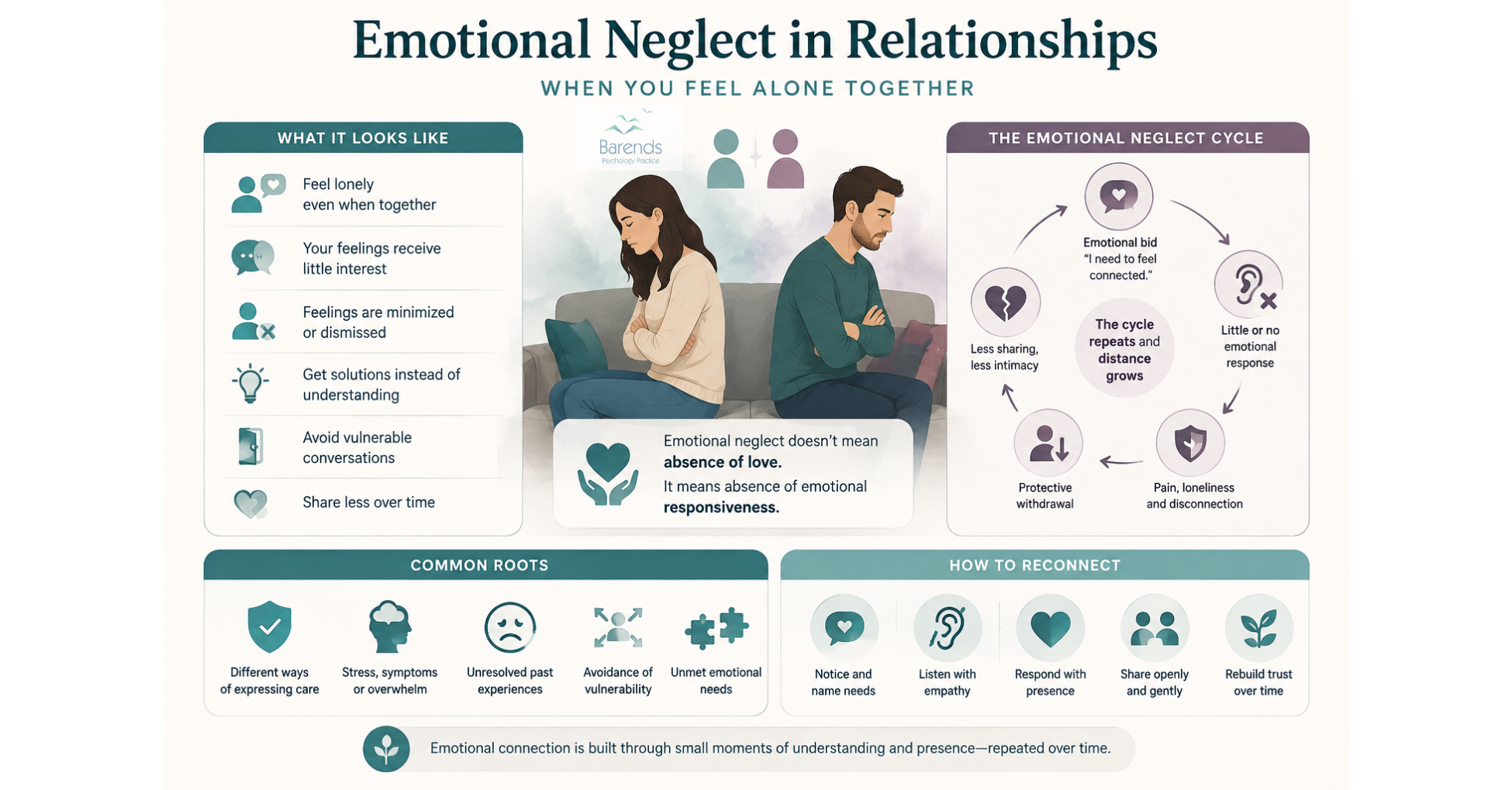
Emotional neglect in relationships at a glance
- Emotional neglect in relationships occurs when emotional needs repeatedly go unnoticed or unanswered.
- It can exist in otherwise stable and functional relationships.
- The neglected partner may feel lonely even when the couple spends a great deal of time together.
- The other partner may genuinely believe they are showing love through responsibility or practical help.
- Emotional neglect can involve limited empathy, little curiosity, lack of reassurance, or avoidance of vulnerable conversations.
- Repeated stonewalling or the silent treatment can deepen emotional neglect.
- Improvement requires more than spending time together. Partners must learn how to recognize and respond to emotional bids.
Do you and your partner express care differently?
One person may show love through emotional attention, while the other shows it through consistency or responsibility. The free Relational Archetype assessment helps you understand the needs and patterns behind these differences.
On this page
- What is emotional neglect?
- Signs of emotional neglect
- Why emotional neglect develops
- What emotional neglect is not
- The emotional neglect cycle
- Attuner and Anchor example
- What it feels like for both partners
- Effects on the relationship
- How to rebuild emotional connection
- When couples therapy may help
- Frequently asked questions
What is emotional neglect in a relationship?
Emotional neglect occurs when a partner’s feelings or attempts to connect repeatedly receive little recognition or response. The person may share something important and receive a distracted answe or no meaningful response at all.
Emotional neglect becomes a relationship pattern when emotional bids are regularly missed or treated as less important than tasks or problem-solving.
For the neglected partner, the repeated message may feel like:
“My feelings are inconvenient.”
“I should handle this alone.”
“My partner cares about what needs to be done, but not about what happens inside me.”
“There is no point sharing because nothing changes.”
The other partner may experience the situation very differently. They may believe that remaining loyal and earning money clearly demonstrates care. They may feel confused or criticized when told that the relationship lacks emotional connection, and could easily deny the idea that they are experiencing relationship problems.
This difference helps explain why emotional neglect in relationships can continue for years without either partner fully understanding what is happening. One person feels emotionally alone, while the other feels that their considerable efforts are being overlooked.
A common example: “I was only trying to help”
Sophie tells her partner that she feels anxious about an upcoming medical appointment. She explains that she keeps imagining bad outcomes and has barely slept.
Her partner immediately looks up the clinic and tells her that worrying will not change the result. He believes he is helping by making the situation more manageable.
Sophie appreciates the practical support but still feels emotionally alone. What she needed first was something closer to:
“That sounds frightening. I understand why you are worried. I will be here with you.”
Common signs of emotional neglect in relationships
Emotional neglect often becomes visible through small, repeated interactions rather than one dramatic event. The following signs matter most when they form a consistent pattern.
Limited emotional interest
- Your partner seldom asks how you feel.
- Personal experiences receive brief or distracted responses.
- Emotional conversations quickly shift toward facts or solutions.
- Your partner knows what happened but not how it affected you.
Feelings are minimized
- You are told that you worry too much.
- Your reactions are described as dramatic or irrational.
- The partner focuses on why you should not feel that way.
- You begin questioning whether your emotional needs are reasonable.
Vulnerability feels one-sided
- You share more about your inner world than your partner does.
- Your partner avoids discussing fear, sadness, shame, or insecurity.
- Important concerns remain at a practical level.
- You know little about what your partner experiences emotionally.
Support is mostly practical
- Your partner solves problems but offers little comfort.
- Tasks receive more attention than distress.
- Affection appears mainly through responsibility or provision.
- You feel guilty asking for reassurance or emotional presence.
You stop reaching out
- You share less because previous attempts felt disappointing.
- You seek support from friends rather than your partner.
- You expect to handle emotional pain alone.
- You feel lonely despite being in a relationship.
Conflict replaces connection
- Requests for closeness are heard as criticism.
- Your partner becomes defensive when emotions are discussed.
- Conversations end in withdrawal or stonewalling.
- The need for connection becomes the source of another argument.
The presence of one or two signs does not automatically mean that a relationship is emotionally neglectful. Stress, grief, illness, work pressure, depression, and temporary exhaustion can all reduce emotional availability. The central question is whether emotional needs repeatedly remain unanswered and whether both partners are willing to discuss the pattern.
Why does emotional neglect develop?
Emotional neglect in relationships often grows from differences in upbringing, communication style, stress responses, and beliefs about what love should look like.
Some people learned that love is demonstrated through loyalty and responsibility. Others learned that love involves curiosity and sharing inner experiences. Both may care deeply, but each may overlook the form of care the other person needs.
1. Emotional needs were not discussed growing up
People often repeat what felt normal in their family. In some homes, practical needs were handled well, but feelings were seldom discussed. Parents may have provided safety and structure while offering little emotional reassurance.
These early experiences also influence the way people develop attachment styles. Someone who rarely experienced emotional responsiveness may learn to suppress their own feelings or struggle to recognize emotional needs in others, while someone whose emotional needs were met inconsistently may become especially sensitive to signs of emotional distance.
As an adult, the person may sincerely believe that caring means being dependable. They may not recognize that a partner also needs emotional curiosity or verbal acknowledgment.
2. Feelings are experienced as problems to solve
Some people respond to distress by immediately looking for a solution. They may ask what action should be taken, which facts matter, or how the situation can be prevented next time.
This can be useful, but emotional support often requires acknowledgment before action. Advice offered too quickly may unintentionally communicate that the feeling itself is inconvenient or unnecessary.
3. Vulnerability feels unsafe
A partner may avoid emotional conversations because vulnerability feels exposing. They may fear being judged or becoming responsible for feelings they do not know how to manage.
For some people, this reaction developed after painful or traumatic experiences. Someone who grew up in an emotionally unpredictable environment or experienced repeated rejection or abuse may learn that expressing emotions is unsafe. In people with complex PTSD (C-PTSD), emotional closeness can activate the same protective responses that once helped them cope with danger, even when their current partner is safe and supportive.
Withdrawal protects them from discomfort in the short term, but it also leaves their partner alone with the emotional experience. Without understanding what is happening beneath the surface, both partners can easily mistake protection for indifference.
4. Chronic stress narrows attention
Work pressure or health problems can reduce emotional availability. The person focuses on getting through each day and pays less attention to subtle signs of distress in their partner.
In some cases, the underlying problem is more than everyday stress. People experiencing burnout often have little emotional energy left after work, while those struggling with PTSD in the workplace may become preoccupied with staying alert, managing anxiety, or recovering from overwhelming experiences. Although the emotional distance is rarely intentional, their partner may still experience it as Emotional neglect in relationships.
Temporary emotional distance may become a long-term pattern when the couple keeps postponing connection until life becomes calmer. Unfortunately, that moment often never arrives unless both partners intentionally make space for emotional connection again.
5. Repeated disappointment changes the relationship
The partner who feels neglected may initially ask for more attention, reassurance or emotional closeness. When these requests repeatedly lead to defensiveness or no lasting change, they may stop asking altogether.
Everyday communication becomes more cautious. Conversations become increasingly practical because discussing emotions no longer feels worthwhile. In some couples, especially those from different cultural backgrounds, misunderstandings about how affection and emotional support should be expressed can reinforce this pattern. You can read more about these differences in our article on cross-cultural relationships.
This withdrawal can make the relationship appear calmer on the surface while emotional intimacy quietly continues to weaken underneath. Partners may argue less, but they also stop turning toward one another for comfort and support.
6. Attachment and relational patterns differ
A person’s attachment style may influence how comfortable they feel with emotional closeness. Someone with more avoidant tendencies may reduce contact when emotions become intense, while a more anxiously attached partner may seek increased reassurance and responsiveness.
The Relational Archetypes add another layer by showing what each partner naturally notices and how they tend to express care. One person may monitor emotional connection, while the other monitors stability or practical functioning.
Emotional neglect in relationships: the Attuner and Anchor perspective
One of the most common misunderstandings I see in couples is that emotional neglect often develops without either partner intending to hurt the other. Instead, both partners believe they are contributing to the relationship, but they define love in different ways.
A good example is the combination of an Attuner and an Anchor. Both partners may deeply love one another, yet each naturally pays attention to different aspects of the relationship.


Example
Sarah tells her husband she has been feeling lonely lately.
He immediately replies:
“But we spent the whole weekend together.”
From his perspective, this proves the relationship is healthy.
What Sarah actually means is:
“I miss feeling emotionally close to you.”
The discussion quickly turns into another disagreement because both partners are answering different questions.
He hears:
“You don’t do enough.”
She is actually saying:
“I don’t feel emotionally connected.”
| Attuner | Anchor |
|---|---|
| Feels loved through emotional responsiveness. | Shows love through responsibility and consistency. |
| Notices emotional distance quickly. | Notices practical problems first. |
| May ask more questions when feeling disconnected. | May offer solutions instead of emotional validation. |
| Experiences emotional neglect when feelings go unnoticed. | Experiences criticism despite trying hard. |
| Growth: ask directly for emotional needs. | Growth: respond to emotions before solving problems. |
The emotional neglect cycle
Emotional neglect in relationships usually develops through repeated interactions rather than one major event. One partner reaches for emotional contact, but the response does not meet the need underneath. The disappointment then shapes what both partners do next.
The partner who feels neglected may ask more questions, become more emotional, or criticize the lack of connection. The other partner may hear these attempts as complaints about everything they already contribute. Feeling unappreciated, they become defensive or withdraw from the conversation.
How the cycle develops
One partner needs emotional support
↓
The response is practical or distracted
↓
They feel unseen and ask for more connection
↓
The other partner hears criticism or dissatisfaction
↓
They defend their efforts or withdraw
↓
The first partner shares less or protests more strongly
↓
Both feel unappreciated and emotionally alone
The original emotional need may disappear beneath a new argument about effort or communication. One person says, “You never listen to me,” while the other responds, “Nothing I do is ever enough.” Both statements contain genuine pain, but neither directly addresses what happened in the first interaction.
What the neglected partner learns
- Sharing feelings leads to disappointment.
- Emotional needs create arguments.
- They must ask repeatedly to receive attention.
- Friends may feel safer to confide in than their partner.
- They may need to become visibly distressed before being taken seriously.
What the other partner learns
- Emotional conversations lead to criticism.
- Their practical contributions are not appreciated.
- They will be blamed even when they try to help.
- It feels safer to avoid emotional discussions.
- More distance may seem easier than another unresolved conversation.
This explains why emotional neglect can become self-reinforcing. The neglected partner becomes more sensitive to signs of distance, while the other becomes more cautious around emotional conversations. Each person’s attempt to protect themselves makes the relationship feel less safe to the other.
The turning point
The cycle begins to change when partners stop debating whether enough love or effort exists and start identifying the missed emotional moment. The useful question is not only, “What did you do?” but also, “What did your partner need from you in that moment?”
How emotional neglect affects both partners
Emotional neglect is often described from the perspective of the partner who feels unseen. While this experience deserves attention, the other partner is often struggling as well. They may genuinely care, yet repeatedly feel that nothing they do is enough. Understanding both perspectives helps couples move away from blame and toward understanding.
The partner who feels emotionally neglected
Emotional neglect in relationships often creates loneliness inside the relationship. The person may stop sharing important experiences because previous attempts felt disappointing. They lower their expectations and begin seeking emotional support elsewhere, sometimes through friends or hobbies.
Many people describe wondering whether they are asking for too much. They often question themselves before questioning the relationship.
- “Maybe I’m too sensitive.”
- “Perhaps I expect too much.”
- “I don’t feel seen anymore.”
- “We’re together, but I feel alone.”
The partner who is accused of emotional neglect
The other partner often experiences something very different. They may believe they are showing love every day by working and solving problems. Being told they are emotionally unavailable can therefore feel deeply unfair.
Some begin feeling that whatever they do will never satisfy their partner. Instead of becoming more emotionally available, they may withdraw because every emotional conversation seems to end in criticism.
- “Nothing I do is ever enough.”
- “I’m trying my best.”
- “Why can’t they see everything I already do?”
- “Every conversation turns into another complaint.”
This explains why emotional neglect is so painful. One partner feels emotionally invisible, while the other feels chronically unappreciated. Both partners are hurting, but neither feels understood by the other.
What happens if emotional neglect in relationships continues?
Emotional neglect rarely damages a relationship overnight. More often, it slowly changes how partners relate to one another. Small disappointments accumulate until emotional distance starts feeling normal.
Communication declines
Partners stop bringing up important emotions because previous conversations felt unhelpful or exhausting.
Resentment develops
Disappointment turns into frustration or emotional distance.
Intimacy decreases
Feeling emotionally disconnected often affects affection and everyday warmth.
Outside relationships become more important
Friends, colleagues, or family may gradually become the primary source of emotional support, increasing the risk of emotional infidelity.
Conflict changes
Arguments become less about the original issue and more about feeling unheard or unappreciated.
Partners emotionally give up
The greatest danger is often not fighting, but no longer expecting emotional connection at all.
For this reason, emotional neglect is often less visible than open conflict, yet it can be equally damaging. Many couples seek therapy not because they argue constantly, but because they gradually stopped feeling emotionally connected.
How to rebuild emotional connection
Recovering from emotional neglect in relationships involves learning to recognize emotional needs that have repeatedly been missed. Small moments of emotional responsiveness usually strengthen a relationship far more than occasional grand gestures.
The goal is not to change your personality. An Anchor does not need to become an Attuner, nor does an Attuner need to stop valuing emotional connection. Instead, both partners learn to recognize what makes the other person feel emotionally safe.
Three questions that often change the conversation
Instead of asking:
“Who’s right?”
Ask:
- What emotion did my partner need me to notice?
- How did my response probably feel to them?
- What would have helped them feel understood before solving the problem?
Couples often discover that they were never arguing about the practical issue itself. They were arguing about whether they felt emotionally understood during the conversation.
When professional help may be useful
If emotional neglect has been present for months or years, changing the pattern can be difficult without guidance. By that point, both partners have usually developed protective habits that unintentionally maintain the cycle. One partner may stop expressing emotional needs altogether, while the other may avoid emotional conversations because they expect criticism or disappointment.
Relationship counseling helps couples recognize these patterns before teaching new communication skills. Once partners understand why they respond differently, it becomes much easier to respond differently.
During therapy we explore how each partner naturally experiences connection and conflict. This often includes attachment patterns, communication styles, and the different ways partners express care. Rather than deciding who is right, the focus is on helping both partners recognize the emotional needs that have been overlooked.
Feeling emotionally alone in your relationship?
Emotional neglect often develops gradually, making it difficult for couples to recognize what is happening. Therapy can help both partners understand the pattern, rebuild emotional safety, and reconnect in ways that feel meaningful to each of them.
Learn about online couples counseling
Online sessions worldwide • In-person sessions in Ljubljana
Frequently asked questions
Frequently Asked Questions About Emotional Neglect in Relationships
Emotional neglect can exist even when love, loyalty, and practical support are present. These questions explain how to recognize the pattern and what couples can do to rebuild connection.
What is emotional neglect in a relationship?
Emotional neglect occurs when one partner’s feelings, emotional needs, or attempts to connect repeatedly receive little recognition or response. The partner may receive advice, practical help, distraction, or silence when they were seeking understanding, comfort, reassurance, or emotional presence.
What are common signs of emotional neglect?
Common signs include feeling lonely despite being together, receiving little interest in your emotional experience, having feelings minimized, receiving solutions instead of empathy, avoiding vulnerable conversations, and gradually sharing less because previous attempts felt disappointing.
Can emotional neglect exist in a loving relationship?
Yes. A partner may be loyal, responsible, dependable, and genuinely loving while still struggling to recognize or respond to emotional needs. Emotional neglect often develops because partners express care differently rather than because one person feels no love.
Is emotional neglect the same as emotional abuse?
No. Emotional neglect usually involves an absence of emotional responsiveness, while emotional abuse involves harmful actions such as intimidation, humiliation, threats, manipulation, or deliberate control. The two can occur together, but emotional neglect may also develop without malicious intent.
Why does my partner offer solutions instead of emotional support?
Some people learned that helping means solving the problem. They may focus on facts, actions, and prevention because this is how they express care. The response becomes emotionally neglectful when practical help consistently replaces curiosity, empathy, validation, or comfort.
Am I asking for too much emotional support?
Wanting interest, empathy, reassurance, affection, and emotional presence is not inherently unreasonable. However, no partner can meet every emotional need at all times. The important questions are whether your needs can be discussed openly, whether your partner makes a genuine effort to respond, and whether responsibility for emotional well-being is shared realistically.
Why have I stopped sharing my feelings with my partner?
People often stop sharing after repeated experiences of feeling dismissed, misunderstood, criticized, or alone. Sharing less protects against another disappointment, but it also reduces the possibility of emotional intimacy and can deepen the distance between partners.
Can emotional neglect lead to emotional infidelity?
Emotional neglect does not automatically cause infidelity. However, when someone consistently feels unseen at home, they may become more vulnerable to forming an emotionally intimate connection elsewhere. This does not remove responsibility for crossing relationship boundaries, but it may help explain the context in which emotional infidelity develops.
Can attachment styles contribute to emotional neglect?
Yes. A person with more avoidant tendencies may feel uncomfortable with emotional dependence or vulnerable conversations. A more anxiously attached partner may need greater reassurance and become especially sensitive to signs of distance. Their attachment styles can intensify the cycle, although attachment does not determine the outcome.
Can emotional neglect be repaired?
Emotional neglect can often be repaired when both partners acknowledge the pattern and are willing to respond differently. Repair usually involves expressing needs directly, listening without immediately defending or solving, recognizing emotional bids, and responding with understanding before moving toward action.
How can I explain emotional neglect to my partner?
Describe specific moments rather than making a broad accusation. For example: “When I told you I was frightened and you immediately gave advice, I felt alone. I needed you to acknowledge how scared I was before helping me solve it.” This gives your partner a clearer understanding of what was missing.
When should couples seek professional help?
Couples therapy may help when emotional needs repeatedly lead to defensiveness, one partner has stopped sharing, resentment is increasing, intimacy has declined, or both partners feel misunderstood despite repeated attempts to improve the relationship.
Can Relational Archetypes explain emotional neglect?
The Relational Archetypes can help explain why partners notice and express care differently. An Attuner may prioritize emotional responsiveness, while an Anchor may show love through stability and responsibility. The framework does not diagnose emotional neglect, but it can make recurring misunderstandings easier to recognize.

Literature and References
Research does not always use the phrase emotional neglect in relationships. Related research often examines perceived partner responsiveness, emotional support, empathic accuracy, emotional expression, attachment, and relationship satisfaction.
-
Reis, H. T. (2023).
Responsiveness in romantic partners’ interactions.
Current Opinion in Psychology, 52, 101597.
View publication
-
Ruan, Y., Reis, H. T., Clark, M. S., Hirsch, J. L., & Bink, B. D. (2020).
Can I tell you how I feel? Perceived partner responsiveness encourages emotional expression.
Emotion, 20(3), 329–342.
View publication
-
Candel, O. S., & Turliuc, M. N. (2021).
The role of relational entitlement, self-disclosure and perceived partner responsiveness in predicting couple satisfaction: A daily-diary study.
Frontiers in Psychology, 12, 609232.
View publication
-
Canevello, A., & Crocker, J. (2010).
Creating good relationships: Responsiveness, relationship quality, and interpersonal goals.
Journal of Personality and Social Psychology, 99(1), 78–106.
View publication
-
Sened, H., Lavidor, M., Lazarus, G., Bar-Kalifa, E., Rafaeli, E., & Ickes, W. (2017).
Empathic accuracy and relationship satisfaction: A meta-analytic review.
Journal of Family Psychology, 31(6), 742–752.
View publication
-
Chervonsky, E., & Hunt, C. (2017).
Suppression and expression of emotion in social and interpersonal outcomes: A meta-analysis.
Emotion, 17(4), 669–683.
View publication
-
Cramer, D. (2004).
Emotional support, conflict, depression, and relationship satisfaction in a romantic partner.
The Journal of Psychology, 138(6), 532–542.
View publication
-
Liu, Y., Chen, X., Li, S., Yu, B., Wang, Y., & Yan, H. (2021).
Childhood emotional maltreatment and adulthood romantic relationship well-being: A multilevel, meta-analytic review.
Trauma, Violence, & Abuse, 24(2), 778–794.
View publication
Evidence note: Emotional neglect is not established by one disappointing interaction. The concern lies in a recurring pattern in which emotional experiences receive little acknowledgment and attempts to discuss the problem lead to dismissal, defensiveness, avoidance, or no meaningful change.