


Relationship problems and communication – silent treatment in relationships
Silent treatment in relationships: Why it happens and how to respond
Why one partner stops communicating and how couples can distinguish punishment from a healthy need for space
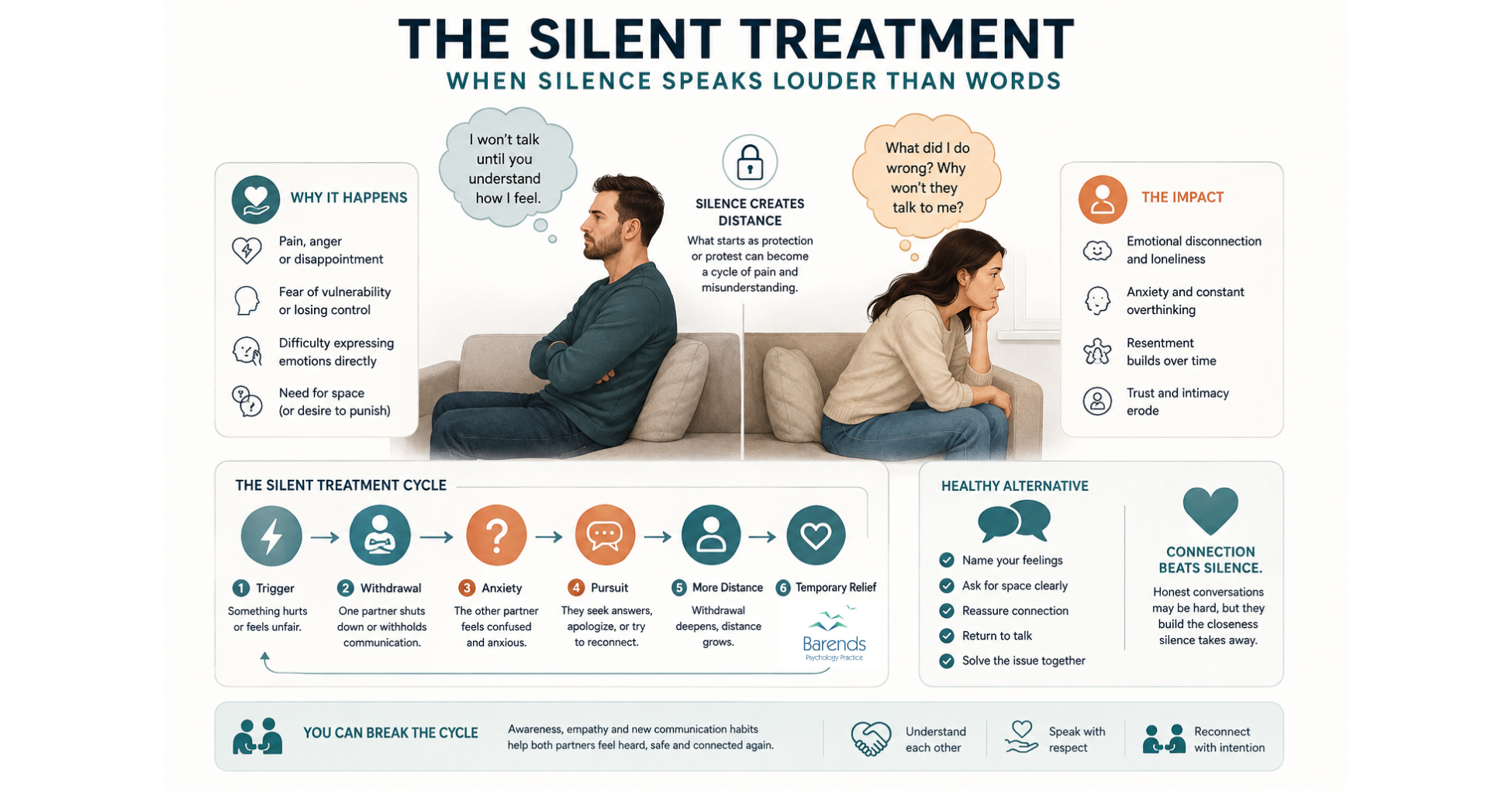
Silent Treatment at a Glance
- The silent treatment involves withholding communication or emotional contact.
- It may include ignoring questions, avoiding eye contact, refusing affection, or acting as though a partner is not present.
- Some people become silent because they feel overwhelmed and do not know how to communicate safely.
- Others use silence to punish a partner or regain control after a disagreement, which often occurs in abusive relationships.
- A healthy pause includes an explanation and an agreed time to continue the conversation.
- The silent treatment often increases anxiety and reassurance seeking in the receiving partner.
- Repeated silence can weaken trust and willingness to discuss difficult subjects.
Why does silence affect you and your partner so differently?
One person may withdraw to reduce tension, while the other experiences the silence as rejection. The free Relational Archetype assessment helps you understand the needs and communication patterns behind these reactions.
On This Page
- What is the silent treatment?
- Signs of the silent treatment
- Why people use the silent treatment
- Silent treatment versus stonewalling
- Healthy space versus punitive silence
- The silent-treatment cycle
- Attuner and Anchor example
- How the silent treatment affects relationships
- How to respond
- How to stop giving the silent treatment
- When couples therapy may help
- Frequently asked questions
What is the silent treatment in a relationship?
The silent treatment in relationships usually serves different purposes. It may express pain that the person cannot communicate directly, and it may also place pressure on the partner to repair the relationship on their behalf.
The person may feel deeply hurt, angry, disappointed, or misunderstood. Yet speaking normally can feel impossible while those feelings remain unacknowledged. Casual conversation may seem like pretending that nothing happened, while initiating the difficult conversation themselves may feel too vulnerable. It can even feel like giving in first.
Instead of saying, “I am hurt and need you to understand why,” they communicate indirectly. Their silence or withdrawal is meant to show that something is wrong. They may hope their partner asks what happened, apologizes, or offers the acknowledgment they are unable to request openly.
1. Silence as protest
In this form, the person is not necessarily trying to end the relationship or dominate their partner. They are trying to communicate emotional pain without naming it directly. The silence may mean:
“You hurt me.”
“You should understand why I am upset.”
“I need you to come toward me first.”
“I cannot act normally until this has been acknowledged.”
The difficulty is that the partner must guess what happened and what response is expected. Asking, “What is wrong?” does not always solve this. Answering may require the silent partner to expose feelings they are trying to protect, and they may still experience initiating the conversation as surrendering their position.
2. Silence as punishment or control
The silence may also be used to make the partner feel the emotional pain or rejection that the silent person is experiencing. Withholding contact can create a temporary sense of power:
“Now you will understand how much you hurt me.”
“I will not reconnect until you apologize.”
“You do not get access to me while I feel this way.”
This position protects the person from having to say, “I feel hurt, weak, afraid, or in need of reassurance.” Remaining silent may feel safer and more powerful than risking an emotional conversation in which they could cry or feel rejected again.
The relationship becomes unhealthy when communication is restored only after the other partner apologizes or behaves in the expected way. At that point, silence is no longer only an expression of pain. It has become a way of controlling how repair takes place.
These two functions often overlap. A person may genuinely feel hurt and unable to speak while also noticing that silence gives them influence over their partner. The behavior may begin as self-protection and later continue because the other person apologizes or gives in.
It means that real emotional pain is being communicated through a strategy that leaves the partner uncertain and responsible for discovering how to restore contact.
A common example
A couple argues because one partner made weekend plans without discussing them first. The other says they feel excluded. The partner who made the plans becomes defensive and says, “Fine. I will not plan anything anymore.”
For the rest of the evening, they stop speaking. The next morning, they answer only practical questions and ignore every attempt to discuss what happened. The other partner apologizes several times, but receives no response.
The original disagreement is no longer the central issue. The receiving partner is now focused on ending the silence, while the silent partner controls when emotional contact becomes available again.
Common signs of the silent treatment in relationships
The silent treatment may be obvious, but it can also take more subtle forms. The person may continue functioning normally while withholding the emotional contact that usually defines the relationship.
Communication is withheld
- Questions are ignored.
- Messages are read but not answered, or only answered with a thumbs-up emoji.
- Only practical information is exchanged.
- The person refuses to explain what is wrong.
- Attempts to repair the conflict receive no response.
Emotional contact is removed
- Eye contact is avoided.
- Affection is suddenly withdrawn.
- The person acts as though the partner is not present.
- Warmth returns only after the partner apologizes or gives in.
- The silence has no clear endpoint.
A brief period of quiet after conflict does not automatically constitute silent treatment. The concern lies in the combination of withdrawal and the absence of a clear route back into communication.
Why do people use the silent treatment?
People use silence for different reasons. For some, it is an automatic reaction to emotional overload. For others, it is a way to express anger without openly discussing it. In more damaging patterns, silence becomes a method of punishment or control.
Understanding the motive matters because someone who feels overwhelmed needs help communicating their need for space. Someone who deliberately uses silence to frighten or pressure a partner must take responsibility for the impact and the controlling function of the behavior.
The way people respond to conflict is also influenced by their attachment style. Someone with an avoidant attachment style may be more likely to withdraw when emotions become intense because distance helps them regain a sense of control. Someone with an anxious attachment style, on the other hand, may become increasingly distressed by the silence and respond by seeking more contact, reassurance, or explanation. These different coping strategies can unintentionally reinforce one another, making it even harder for both partners to reconnect.
1. Emotional overload
Some people become silent because their thoughts and emotions feel too difficult to organize. They may fear crying or saying something they will regret. Silence gives them temporary relief from the pressure of responding.
The problem arises when the person does not explain this need. What feels like self-protection to them may feel like abandonment or punishment to their partner.
2. Difficulty expressing anger
Some people grew up in families where anger was discouraged or ignored. They may have learned that openly saying, “I am angry with you,” is unsafe or unacceptable.
Instead, anger is communicated through distance. The partner can clearly feel that something is wrong, but receives no words that would allow the issue to be understood or resolved.
3. Fear of conflict
A person may expect every disagreement to end in criticism or escalation. Silence appears safer than entering a conversation in which they expect to lose or feel exposed.
Avoiding the conflict may reduce anxiety in the moment, but it also prevents the couple from learning that difficult conversations can be handled safely.
4. Avoiding responsibility
Continuing the conversation may require the person to acknowledge harm or change their behavior. Silence delays that moment and may eventually cause the other partner to abandon the subject.
When this happens repeatedly, unresolved problems accumulate and the other partner begins carrying more of the emotional work in the relationship.
5. Punishment or control
In some relationships, silence is used because the person knows it causes distress. Communication returns only after the partner apologizes, gives up a boundary, accepts blame, or behaves in the expected way.
Here, the silence is not simply a failure to communicate. It is used to shape the partner’s behavior. When this forms part of a wider pattern of intimidation or control, the relationship may require more than ordinary communication advice.
Silent treatment versus stonewalling
The terms silent treatment and stonewalling are often used interchangeably because both involve withdrawal from communication. The main distinction lies in the function of the silence.
Stonewalling often begins when someone becomes emotionally flooded and loses the ability or willingness to participate in a conversation. The silent treatment more strongly implies that communication itself is being withheld, often to express anger, punish, or influence the partner.
| Feature | Stonewalling | Silent treatment |
|---|---|---|
| Common trigger | Emotional flooding or feeling unable to continue. | Anger, hurt, resentment, or a wish to influence the partner. |
| Internal experience | “I cannot manage this conversation.” | “I will not communicate until something changes.” |
| Purpose | Escape or self-protection. | Withdrawal of contact, punishment, protest, or control. |
| Typical endpoint | May end after emotional arousal decreases. | May end after the partner apologizes, gives in, or stops raising the issue. |
Important: The distinction is not always clear from one interaction. A person may begin by feeling overwhelmed and later continue the silence because it gives them power or helps them avoid the issue. Look at the recurring pattern, the duration, what ends the silence, and whether the person accepts responsibility for returning to the conversation.
Healthy space versus punitive silence
The clearest way to distinguish healthy space from the silent treatment is to ask whether the pause preserves the connection. Someone taking healthy space may stop talking, but they still acknowledge the relationship and take responsibility for returning.
Punitive silence removes connection. The receiving partner is left without information, reassurance, or a reliable endpoint. Instead of helping the conversation recover, the silence becomes a second conflict layered on top of the first.
| Healthy space | Silent treatment |
|---|---|
| “I am overwhelmed and need an hour before we continue.” | No explanation is given. |
| The person reassures the partner that the relationship remains intact. | Emotional contact is removed. |
| A specific time is suggested for returning to the conversation. | The partner does not know when communication will resume. |
| The pause is used to calm down and prepare. | The silence pressures the partner to apologize or give in. |
| The person returns and participates. | The original issue disappears only because the other person stops asking. |
The silent treatment cycle
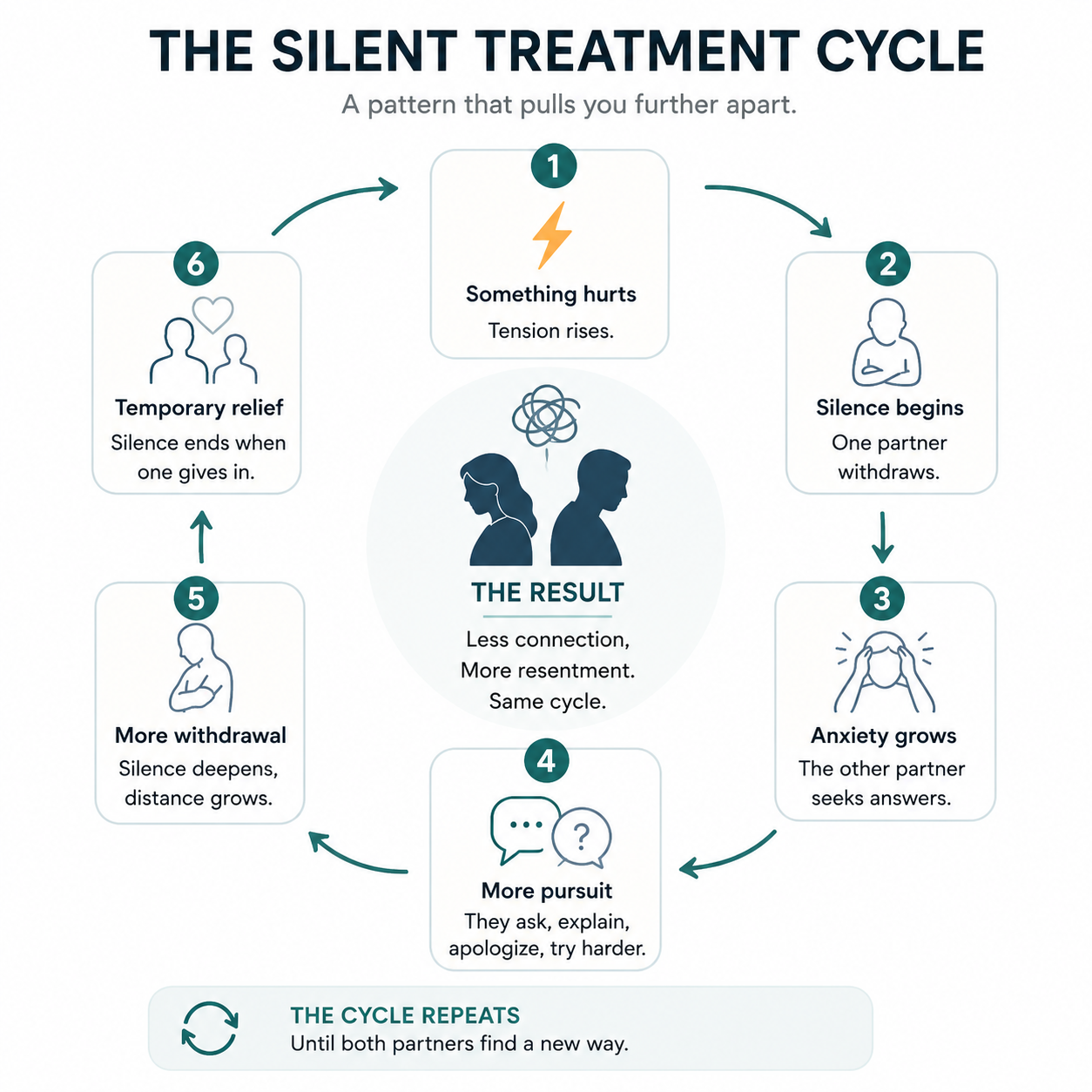
The silent treatment rarely ends after a single conversation. Instead, it often develops into a predictable cycle. One partner feels hurt, disappointed, or angry but struggles to express these feelings directly. Rather than talking about them, they withdraw and stop communicating.
The other partner experiences the silence as emotional distance and starts trying to reconnect. They may apologize, explain themselves again, or repeatedly ask what is wrong. Ironically, these attempts can make the silent partner feel even more pressured, causing them to withdraw further.
Eventually one partner often gives in, not because the problem has been resolved, but because they can no longer tolerate the distance. Although this temporarily restores contact, the original issue often remains unresolved, making it likely that the same pattern will return during the next disagreement.
The Attuner and the Anchor
The silent-treatment cycle can be particularly painful when an Attuner and an Anchor respond to conflict in opposite ways. The Attuner tries to restore connection, while the Anchor often tries to restore calm.
Example: “Why won’t you talk to me?”
Laura and Daniel argue because Daniel agreed to host family members for the weekend without checking with her. Laura says she feels that her needs were ignored. Daniel believes she is turning a practical decision into a much larger relationship problem.
Daniel becomes quiet because he feels criticized and wants the argument to stop. Laura notices the shift immediately and asks whether he is angry. When he does not answer, she asks again. Daniel feels increasingly pressured and stops speaking altogether.
Laura experiences the silence as withdrawal of love and emotional safety. Daniel experiences her continued questions as proof that he is not being allowed to settle. Their different attempts to feel safe begin working against each other.

The Attuner closely monitors emotional contact. Silence is unlikely to feel neutral. It may be interpreted as evidence that the relationship is damaged or that something important is being hidden.
When the Attuner receives the silent treatment:
- Notices the emotional distance quickly.
- Asks what is wrong.
- Seeks reassurance that the relationship is safe.
- May apologize prematurely to restore contact.
- Finds it difficult to leave the silence alone.
When the Attuner gives the silent treatment:
- May withdraw after feeling repeatedly unheard.
- Hopes the partner notices the emotional injury.
- May expect the partner to initiate repair.
- Can use silence as a test of whether the partner cares.

The Anchor usually seeks stability and lower emotional intensity. When a conversation feels chaotic or repetitive, becoming quiet may feel like the most responsible way to prevent further escalation.
When the Anchor receives the silent treatment:
- May initially respect the partner’s distance.
- Assumes the person needs time.
- Waits longer before raising the issue again.
- Eventually becomes frustrated by continued uncertainty.
- Wants clear rules for when communication resumes.
When the Anchor gives the silent treatment:
- May believe silence is calmer than arguing.
- Reduces communication to avoid further disruption.
- May underestimate how threatening the silence feels.
- Can delay returning because the relationship appears stable to them.
The Relational Archetypes describe what people tend to notice and protect. They do not excuse withholding communication or predict abusive behavior. An Attuner can punish through silence after feeling unseen, while an Anchor can remain quiet because they believe they are preventing escalation.
How the silent treatment affects a relationship
Repeated silent treatment changes more than the outcome of one argument. It affects whether the relationship feels emotionally safe enough for honesty.
What it may feel like for the receiving partner
- Feeling invisible or emotionally abandoned.
- Constantly monitoring for signs that contact will return.
- Apologizing without understanding what they did wrong.
- Doubting their own judgment.
- Becoming afraid to raise difficult subjects.
- Feeling that affection is conditional.
- Losing confidence that conflicts can be resolved safely.
What it may feel like for the silent partner
- Feeling unable to manage the intensity of the conversation.
- Believing that anything they say will make matters worse.
- Feeling entitled to distance after being hurt.
- Expecting the partner to understand why they are angry.
- Experiencing repeated questions as pressure.
- Feeling calmer once communication stops.
- Failing to recognize how strongly the silence affects the partner.
The receiving partner may eventually stop raising important concerns because the cost feels too high. This can create surface-level peace while resentment and emotional distance continue to grow underneath.
How to respond to the silent treatment
A helpful response combines openness with a clear boundary.
Name what you notice
Use a calm observation rather than an accusation: “I notice that you have stopped responding to me since our disagreement.”
Offer a structured pause
Ask whether your partner needs time and suggest a clear point for reconnecting: “Would you like an hour, and can we talk again at eight?”
Do not repeatedly beg for contact
Repeated apologies or questions can reinforce the idea that withholding communication is an effective way to gain power or avoid the issue.
Set a boundary around indefinite silence
You can respect a need for space while saying that days of unexplained silence are not an acceptable way to manage conflict.
Return to the original issue
Do not allow the conflict to disappear simply because communication resumes. The original disagreement still requires attention.
Look at the wider pattern
Consider what triggers the silence, how long it lasts, what ends it, and whether both partners accept responsibility for changing the cycle.
How to stop giving your partner the silent treatment
Stopping the silent treatment does not mean forcing yourself to talk while emotionally overwhelmed. It means replacing unexplained withdrawal with a clear request for space and returning when you said you would.
- Name the emotion directly. Say that you feel angry, hurt, ashamed, or overwhelmed instead of expecting your partner to infer it.
- Ask for space clearly. Explain why you need a pause and how long you expect to need.
- Offer reassurance. Clarify that you are pausing the conversation rather than withdrawing from the relationship.
- Return at the agreed time. Trust cannot improve when promises to resume communication are repeatedly broken.
- Express the need underneath the silence. You may need acknowledgment, an apology, calm, respect, or time to think.
- Accept responsibility for the impact. Your intention may have been self-protection, but your partner may still have experienced the silence as punishment.
A healthier alternative
“I am angry and too overwhelmed to discuss this respectfully right now. I need some time alone, but I do want to resolve it. Can we continue after dinner?”
When couples therapy may help
Couples therapy may be useful when silence repeatedly replaces conflict resolution, one partner feels increasingly desperate for contact, or both partners have lost confidence that difficult subjects can be discussed safely.
Therapy can help identify what the silence protects and which agreements are needed to create safe pauses. It can also help distinguish emotional overload from punishment or controlling behavior.
Has silence replaced communication in your relationship?
Professional support can help you identify the cycle and create a reliable way to reconnect after conflict.
Frequently asked questions
Frequently Asked Questions About the Silent Treatment
The silent treatment can reflect hurt, overload, protest, avoidance, or a wish to influence the other person. Understanding what the silence is doing within the relationship is essential.
What is the silent treatment in a relationship?
The silent treatment occurs when one partner withdraws normal communication or emotional contact after feeling hurt, angry, disappointed, or criticized. They may ignore questions, avoid eye contact, answer only practical matters, or act as though their partner is not present.
Why do people give their partner the silent treatment?
Some people use silence because they cannot express hurt or anger directly. Speaking normally may feel like pretending that nothing happened, while starting the conversation themselves may feel too vulnerable. Others use silence to punish their partner, force an apology, avoid responsibility, or regain a sense of control.
Is the silent treatment emotional abuse?
A single episode of withdrawal does not automatically constitute emotional abuse. The pattern becomes more concerning when silence is repeatedly used to frighten, punish, destabilize, or control a partner. Warning signs include requiring the partner to accept blame, abandon a boundary, or beg for contact before communication returns.
What is the difference between the silent treatment and stonewalling?
Stonewalling often describes shutting down because a person feels emotionally overwhelmed and unable to continue. The silent treatment more strongly suggests that communication is being withheld to express hurt, provoke a response, punish the partner, or influence how the conflict ends. The two patterns can overlap.
Is asking for space the same as giving the silent treatment?
No. Healthy space includes a brief explanation, reassurance that the relationship remains intact, and a clear intention to return. The silent treatment leaves the partner uncertain about why communication stopped, how long it will last, and what they must do to restore contact.
Why does the silent treatment hurt so much?
The receiving partner loses access to information, reassurance, and emotional contact. They may not know whether the relationship is secure or what is expected of them. This uncertainty can trigger anxiety, self-doubt, anger, shame, and a strong urge to restore connection.
Why do I keep asking questions when my partner goes silent?
Asking questions is often an attempt to reduce uncertainty and repair the emotional distance. Unfortunately, repeated pursuit may feel like pressure to the silent partner, causing them to withdraw further. This creates a pursue-withdraw cycle in which both reactions strengthen the other.
Should I apologize to end the silent treatment?
Apologize when you understand what you did and genuinely believe an apology is appropriate. Repeatedly accepting blame merely to restore communication can reinforce the silence. It also prevents both partners from addressing the original disagreement honestly.
How should I respond when my partner gives me the silent treatment?
Calmly name what you notice and ask whether your partner needs space. Suggest a specific time to continue the conversation. Avoid begging repeatedly for contact, but make it clear that unexplained or indefinite silence is not a healthy way to manage conflict.
How can I stop giving my partner the silent treatment?
Start by naming what you feel and what you need. Instead of withdrawing without explanation, say that you feel hurt, angry, or overwhelmed. Ask for a defined pause, reassure your partner that you intend to return, and resume the conversation when you said you would.
Can attachment styles influence the silent treatment?
Yes. Someone with a more avoidant attachment style may rely on distance when emotions become intense. A more anxiously attached partner may experience that distance as a threat and seek immediate reassurance. Attachment does not excuse punitive silence, but it may help explain why the cycle becomes so intense.
Do certain Relational Archetypes use the silent treatment more often?
No archetype is naturally destined to use the silent treatment. The Relational Archetypes help explain what people seek during conflict. An Attuner may withdraw after feeling unseen and hope their partner initiates repair. An Anchor may become quiet to reduce tension and underestimate how threatening the silence feels. The motive and wider pattern remain more important than the label.
When should couples seek professional help?
Couples therapy may help when silence regularly replaces communication, one partner feels increasingly desperate or powerless, apologies are demanded before contact resumes, or neither partner knows how to discuss conflict safely. Individual support may be more appropriate when the silence forms part of a wider pattern of intimidation, coercion, or emotional abuse.

Literature and References
Research commonly examines the silent treatment as communication avoidance, social exclusion, ostracism, emotional withdrawal, or part of a demand-withdraw interaction pattern.
-
Dubey, A., Kumar, R., Srivastava, A., et al. (2026).
Antecedents and consequences of silent treatment in close adult relationships: A systematic review.
Frontiers in Psychology.
View publication
-
Baucom, B. R., McFarland, P. T., & Christensen, A. (2015).
The interpersonal process model of demand/withdraw behavior.
Journal of Family Psychology, 29(1), 80–90.
View publication
-
Eldridge, K. A., Sevier, M., Jones, J., Atkins, D. C., & Christensen, A. (2007).
Demand-withdraw communication in severely distressed, moderately distressed, and nondistressed couples.
Journal of Family Psychology, 21(2), 218–226.
View publication
-
Baucom, B. R., McFarland, P. T., Atkins, D. C., et al. (2011).
The language of demand/withdraw: Verbal and vocal expression in dyadic interactions.
Journal of Family Psychology, 25(4), 570–580.
View publication
-
Wirth, J. H., Sacco, D. F., Hugenberg, K., & Williams, K. D. (2010).
Eye gaze as relational evaluation: Averted eye gaze leads to feelings of ostracism and relational devaluation.
Personality and Social Psychology Bulletin, 36(7), 869–882.
View publication
-
Wilde, J. L., et al. (2024).
Gender, attachment, and demand-withdraw patterns in the context of moderate couple conflict.
Journal of Marital and Family Therapy.
View publication
-
Williams, K. D., et al. (2025).
The quiet cruelty: Ostracism as intimate partner violence.
Current Opinion in Psychology.
View publication
Evidence note: Silence cannot be interpreted accurately without context. A temporary pause that is explained and followed by renewed communication may support emotional regulation. Repeated silence that forces the other partner to guess, apologize, submit, or abandon the subject has a different function and may be psychologically damaging.