


Obsessive-Compulsive Personality Disorder – OCPD causes
What Causes OCPD?
How early experiences and rewarded behavior may shape a strong need for correctness and control

OCPD Causes at a Glance
- No single cause of OCPD has been identified.
- Genetic influences and temperament may contribute to vulnerability.
- Family expectations can shape how a person relates to mistakes and control.
- Perfectionistic behavior may become stronger when it repeatedly brings praise or relief.
- The same environment can affect children differently because temperament and interpretation also matter.
- Understanding possible causes does not mean blaming parents or the person with OCPD.
Do you recognize OCPD patterns?
The free OCPD screening questionnaire explores perfectionism, rigid standards, difficulty delegating, overwork, and the need to remain in control. A psychologist can help clarify whether these patterns reflect OCPD or another difficulty.
An online questionnaire cannot diagnose OCPD. Diagnosis requires a professional assessment.
On This Page
Is there one cause of OCPD?
Imagine two sisters growing up in the same family. Their parents both work long hours and often come home tired. The eldest daughter notices the house becoming untidy and begins helping without being asked. She clears the table, folds the laundry, and keeps her room meticulously organized. Her parents appreciate her efforts and regularly tell her how reliable and responsible she is.
Her younger sister grows up in exactly the same home. She also helps occasionally, but she experiences the situation differently. Being younger, she simply enjoys playing and assumes that the adults will take care of most things. She receives the same love from her parents but never develops the same sense that keeping everything in order is her responsibility.
For the eldest daughter, taking responsibility becomes closely linked to praise and feeling valued. Cleaning and preventing problems are rewarding, because they help the family and because they become part of how she understands herself.
Years later, these patterns may have become so automatic that she feels uncomfortable when things are left unfinished or done differently than she would have done them herself. The younger sister, despite growing up in the same household, may never develop these tendencies. This illustrates why OCPD causes cannot be explained by one parenting style or one childhood experience. Personality develops through the interaction between temperament, life experiences, and the meaning a person gives to those experiences.
For someone who later develops OCPD, a set of conclusions may become especially influential:
- “Mistakes can be prevented if I am careful enough.”
- “Being responsible is how I earn respect.”
- “If I relax, something important may be missed.”
- “Other people may not take things as seriously as I do.”
- “There is a correct way, and it is my job to find it.”
These beliefs can organize a person’s life. They influence how the person approaches work and relationships. They may also become difficult to question because they are often connected to real achievements. The person may have avoided mistakes and earned recognition.
This is part of what makes OCPD difficult to recognize. The person does not only experience pressure from their standards; they may also experience those standards as the reason they have succeeded.
Are OCPD causes genetic?
Research suggests that inherited influences contribute to personality development, including traits associated with OCPD. This does not mean that someone inherits a fixed OCPD diagnosis. A person may inherit a temperament that makes certain responses more likely.
Some children are naturally more cautious or uncomfortable with uncertainty. They may notice inconsistencies quickly and prefer clear expectations. In a supportive environment, these qualities can develop into careful judgment and dependable behavior. In another environment, the same qualities may become tied to self-criticism or fear.
Temperament therefore describes a starting point. It may influence which lessons feel most convincing and which strategies a child uses when seeking approval or competence.
Parenting and learning
Let’s return to the example of the two sisters. Their parents never intended for one child to become highly perfectionistic. They simply worked long hours and appreciated the help they received from their eldest daughter.
For the eldest daughter, these moments were meaningful. Every compliment reinforced the idea that being organized and responsible was valuable. She wasn’t cleaning because she feared making mistakes; she was cleaning because it made her feel appreciated and, perhaps subconsciously also, connected to her family.
As the eldest daughter grew older, the behaviour itself became less important than what it represented. Being responsible was no longer just something she did: it became part of who she was. Leaving something unfinished or watching someone else do a task differently could begin to feel personally uncomfortable because it conflicted with this identity.
Of course, many children receive praise for being responsible without ever developing Obsessive-Compulsive Personality Disorder. In the case of the eldest sister, however, tidying up and taking responsibility became so automatic that not doing these things created feelings of restlessness or dissatisfaction. Each time she cleaned or prevented a problem, those uncomfortable feelings subsided. Without realizing it, she was beginning to reinforce the very pattern that had once simply been a helpful strength.
How perfectionism reinforces itself
As the eldest sister grows older, the same pattern continues. At school she hands in assignments early and receives good grades. At university she prepares more thoroughly than her classmates. Later, at work, colleagues describe her as dependable and her manager trusts her with important projects. Once again, being careful and taking responsibility produce positive results.
Each success strengthens the same lesson she began learning as a child: “When I stay in control and do things properly, good things happen.” The strategy is rewarded so often that she no longer questions it. It simply becomes the way she approaches almost everything.
Psychologists refer to this process as reinforcement. Behaviors that repeatedly produce positive outcomes become easier to repeat. They require less conscious effort because they have become reliable and deeply practiced.
When a project succeeds, she concludes that her careful preparation made the difference. When something goes wrong, she often assumes she should have prepared even better. In both situations, the same conclusion becomes stronger: “I need to stay in control.”
Other ways of responding receive less practice. Delegating feels uncomfortable because other people may not work as carefully. Leaving something unfinished creates tension. Without realizing it, the strategies that once helped her succeed have become increasingly difficult to switch off.
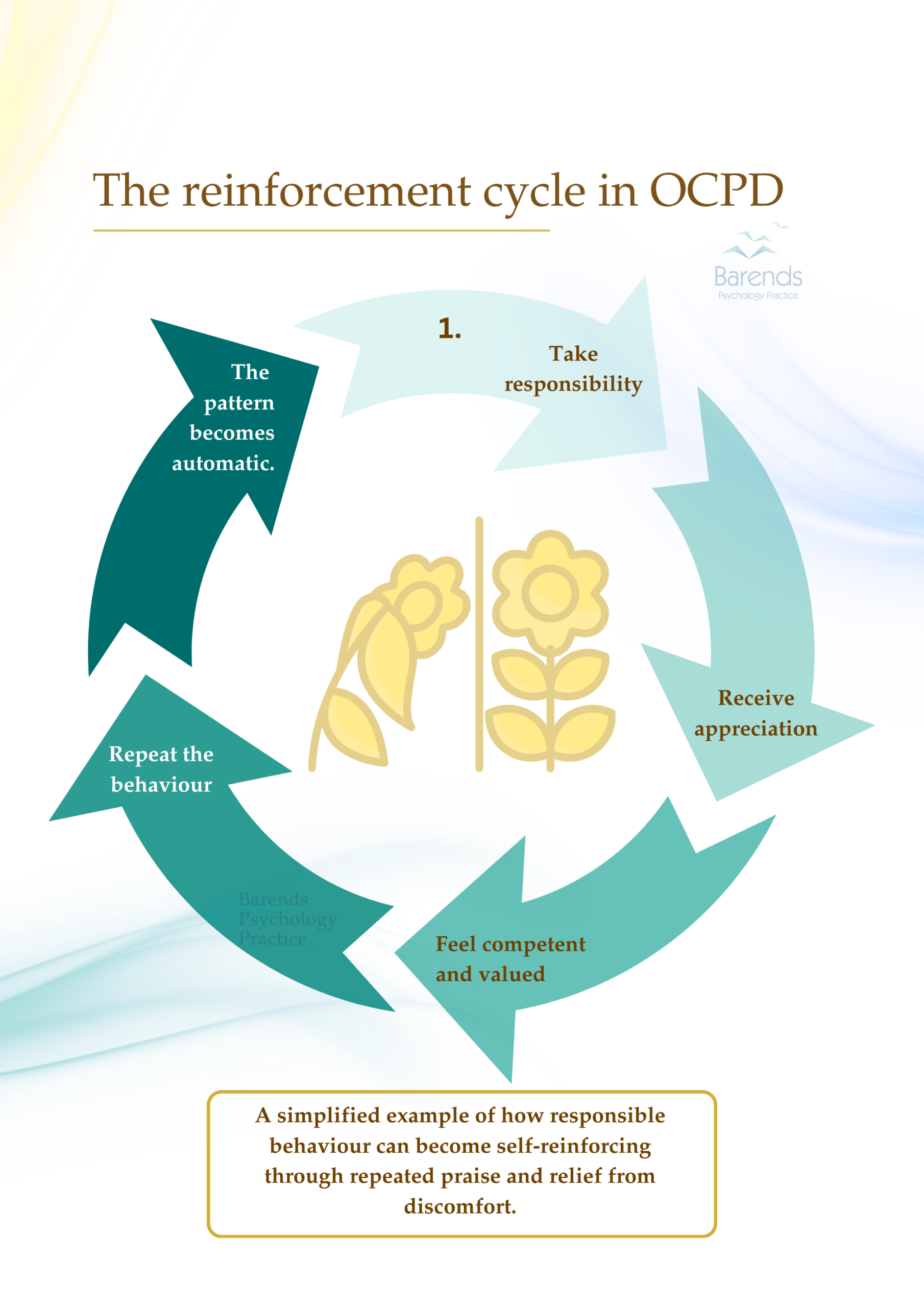
The reinforcement Cycle
In our example, the eldest sister repeatedly experienced that taking responsibility led to appreciation and a sense of relief. Each repetition strengthened the same lesson. The cycle below illustrates how this process can gradually become self-reinforcing.
Take responsibility →
Receive appreciation →
Feel competent and valued →
Repeat the behaviour →
The pattern becomes increasingly automatic.
This strengthening of one successful strategy helps explain why personality patterns can become remarkably stable. The more often a particular way of thinking or behaving is rewarded, the more naturally it becomes the person’s default response. A similar principle is described in the 20–80 Method explanation of how strengths can become weaknesses, which explores how repeatedly relying on the same strengths can gradually reduce psychological flexibility.
Professional patterns
OCPD through the lens of the 20–80 Method
The 20–80 Method offers another way of understanding why successful patterns can become increasingly rigid. People tend to rely on the approaches that have worked well for them. When careful planning or personal effort repeatedly produce good results, those behaviors become easier to trust.
For someone with Obsessive-Compulsive Personality Disorder, this can strengthen an existing belief that control prevents failure. The person may respond to new demands by using even more of what has worked before: more preparation, more supervision, more rules, or more personal effort.
Stress can narrow this response further. Instead of trying a different approach, the person may become more dependent on their strongest pattern. The behavior may still look productive from the outside, but flexibility and trust disappear.
When success makes letting go more difficult
Imagine the eldest sister becoming a founder who has built a successful company through hard work and close attention to quality. During the early years, she was involved in almost everything. She reviewed proposals and solved operational problems. These habits helped the company survive and employees saw her as committed and knowledgeable. Her success seemed to confirm a familiar belief:
“The company succeeds because I stay closely involved.”
As the company grows, close involvement is no longer possible. More employees are hired and managers begin making decisions without her. Delegation should reduce her workload, but it creates discomfort. Other people work differently or make choices she would not have made.
She begins checking their work more closely and rewrites documents. She joins meetings that no longer require her and takes tasks back when the result does not meet her standards. Employees become less willing to make independent decisions because they expect their work to be corrected. Some leave because they feel they are not trusted.
The founder interprets this loss of initiative as proof that her employees cannot handle enough responsibility. She works longer hours and becomes more frustrated. The company depends on her more precisely because her behavior has made it harder for other people to contribute.
The professional feedback loop
An employee makes a mistake →
The founder increases supervision →
Employees take less initiative →
More work returns to the founder →
She becomes exhausted and increases control again.
Burnout becomes increasingly likely because the founder is no longer only completing her own work. She is also reviewing or redoing tasks assigned to others. She may feel disappointed in her team, while her employees feel that genuine ownership is impossible.
The Same OCPD pattern in an Architect and an Operator
The founder’s need for control may not look the same in every professional pattern. The 20–80 Method describes five Professional Archetypes that reflect what people naturally rely on when solving problems and leading others.
OCPD does not determine someone’s archetype, and an archetype cannot diagnose OCPD. The archetype may help explain where the person places their effort when stress makes their standards more rigid.

Builds systems and organized ways of working

Maintains execution and reliable delivery
| Professional pattern | What the founder tries to protect | How OCPD may appear under stress | Effect on employees |
|---|---|---|---|
| Clear structure and a reliable framework for the company | She responds to uncertainty by creating more procedures, revising systems, adding approval steps, or redesigning processes that employees have only just learned. | Employees may feel that the rules keep changing and that nothing is ever sufficiently organized or complete. | |
| Reliable execution and work completed to the expected standard | She responds to pressure by checking more work, stepping into daily operations, redoing tasks, and working longer hours to keep everything moving. | Employees may feel micromanaged and stop taking ownership because the founder is likely to take the work back anyway. |
The Architect’s blind spot
She may believe that a better system will solve the problem, while employees experience constant redesign as another form of control. Structure begins to replace judgment and flexibility.
The Operator’s blind spot
She may believe that taking over protects quality, while her employees become less capable of carrying responsibility. Personal effort begins to replace trust and leadership.
Both founders may end up exhausted and convinced that other people are unreliable. The Architect becomes trapped in repeated redesign. The Operator becomes trapped in repeated execution. In each case, the founder relies more heavily on the strength that once created success, even when that strength is now limiting the company.
Which professional pattern do you rely on under pressure?
The free 20–80 Method Assessment identifies the Professional Archetype that most strongly shapes how you make decisions, and respond when pressure increases.
Take the free 20–80 Method assessment
The 20–80 Method assessment is not a diagnostic test for OCPD or any other mental health condition.
Understanding the cause is only the beginning
Learning how an OCPD pattern developed can make the behavior easier to understand. Treatment focuses on what happens now: how to reduce rigid rules, tolerate uncertainty, delegate more freely, and respond differently when the urge to take control appears.
About this article
This article was written by Niels Barends, MSc, psychologist and founder of Barends Psychology Practice. It combines current psychological research on Obsessive-Compulsive Personality Disorder (OCPD) with more than 14 years of clinical experience working with personality patterns, perfectionism, burnout, and relationship difficulties.
The section describing the 20–80 Method presents an additional framework for understanding how repeatedly reinforced strengths may gradually develop into rigid operating patterns. This model complements rather than replaces established psychological theories of personality development.
This article is intended for educational purposes and should not be used as a substitute for a professional psychological assessment or diagnosis.
Frequently Asked Questions
What causes OCPD?
There is no single cause of OCPD. Research suggests that temperament, childhood experiences, learning, and repeated reinforcement all contribute to the development of obsessive-compulsive personality traits.
Is OCPD caused by strict parents?
Not necessarily. Some people with OCPD grew up with strict parents, while others describe supportive and loving childhoods. What appears to matter is how a child’s temperament interacts with their experiences and what they learn about responsibility, mistakes, and achievement.
Can two siblings develop differently?
Yes. Even children raised in the same household may interpret experiences differently because they have different temperaments, roles within the family, and personal experiences.
Are OCPD causes genetic?
Research suggests that inherited personality traits may increase vulnerability, but no single gene causes OCPD. Genetics interact with learning and life experiences throughout development.
Can OCPD change?
Yes. Although personality patterns often become deeply established, many people develop greater flexibility through psychotherapy, increased self-awareness, and repeated practice with new ways of responding to uncertainty and responsibility.
What is the difference between OCPD and OCD?
OCPD is a personality pattern characterized by perfectionism, control, and rigid standards. OCD is an anxiety-related disorder involving intrusive thoughts and compulsive behaviors. Although the names are similar, they are different conditions and require different approaches to treatment.
References
- American Psychiatric Association. (2022). Diagnostic and Statistical Manual of Mental Disorders (5th ed., text rev.; DSM-5-TR). American Psychiatric Association Publishing.
- Cain, N. M., Ansell, E. B., Simpson, H. B., Pinto, A., & Grilo, C. M. (2015). Interpersonal functioning in Obsessive-Compulsive Personality Disorder. Journal of Personality Disorders.
- Fineberg, N. A., et al. (2020). Obsessive-Compulsive Personality Disorder: A review of diagnostic criteria, epidemiology, and treatment. CNS Spectrums.
- Samuel, D. B., & Widiger, T. A. (2010). A meta-analytic review of the relationships between the five-factor model and DSM personality disorders. Clinical Psychology Review.
-
Barends, B. (2026). The 20–80 Method: Reinforced strengths and professional operating patterns. Available at:
https://2080method.com/