


Relationship dynamics assessment
Every relationship develops its own inner pattern
A relationship assessment can help explain why two people who care deeply for one another still experience the same moments in completely different ways. One partner may seek closeness when something feels uncertain. The other may need space before they can understand what they feel.
Each partner may feel that they are reaching toward the relationship, while missing the form of connection the other person is trying to offer.
The Relationship Assessment builds upon the Relational Archetypes and the Relationship Under Pressure model to make these interaction patterns visible. It helps both partners understand what they naturally seek from connection and what happens when both nervous systems become activated at the same time.
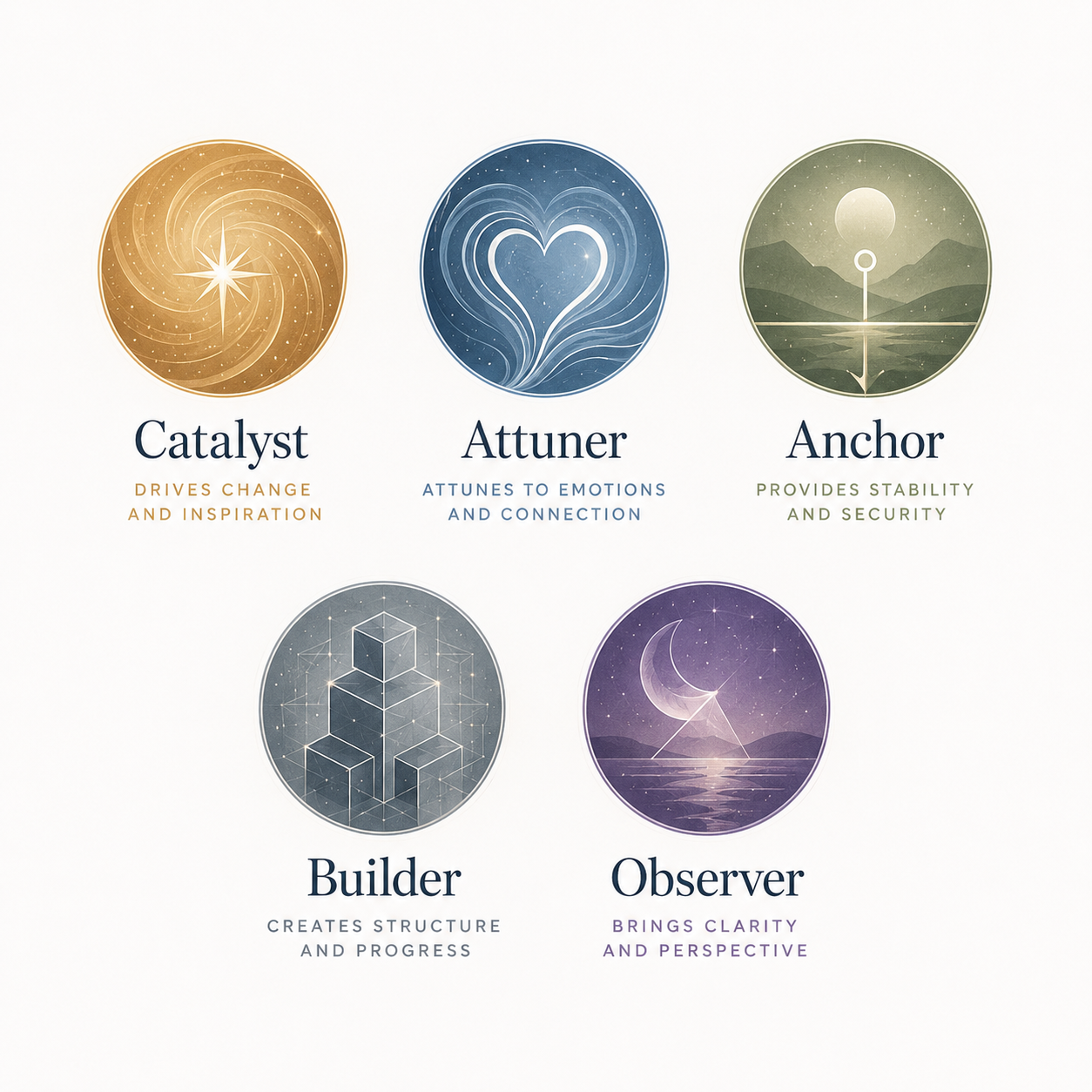
Every person expresses all five Relational Archetypes to some degree. Most people are influenced primarily by two archetypes. The interaction between these patterns shapes communication, emotional needs, conflict, and connection. Learn more about the five Relational Archetypes or explore the individual Relational Archetype Reports.
Why the same conflicts keep returning
Many relationship problems keep returning because the underlying issue remains unresolved. Couples discuss the visible disagreement while the deeper relational pattern stays unchanged.
Frustration builds when partners repeatedly feel misunderstood or emotionally disconnected, because it change the conversation. The interaction pattern, however, stays the same.
The Relationship Assessment identifies these recurring interaction patterns and explains how they develop, helping both partners understand what has been happening beneath the conversation itself.
Beneath the surface
“You never listen to me.”
“I do not feel emotionally received.”
“If I stop reaching for connection, I may lose something important between us.”
Every relationship begins with two unique relational profiles
The Relationship Assessment explores how each partner’s Relational Archetype blend interacts with the other person’s blend. It then examines how those interaction patterns change when either partner experiences emotional pressure.




Want to understand the framework first?
Explore the five Relational Archetypes, discover your personal profile through the Relational Archetype Reports, or learn more about online relationship counselling if you are looking for therapeutic support.
A Relationship-Centred Approach
The assessment explores the relationship between your patterns
Most personality assessments describe each partner separately. This assessment examines the relational system created when two individual patterns meet.
Your relational archetype blend shapes what you notice in relationships and what helps you feel secure. Your partner brings a different internal map. The relationship develops where these maps overlap or create friction.
The analysis then adds each partner’s stress response. This reveals how familiar strengths can become protective strategies during emotional strain, and how one person’s attempt to feel safer can activate the other person’s vulnerability.
Four levels of relationship interaction
The final report brings together four distinct interaction patterns within your relationship.
01
Partner A’s Blend × Partner B’s Blend
How your natural relationship styles combine during everyday connection and shared decision-making.
02
Partner A’s Blend × Partner B Under Stress
How one partner’s usual way of connecting responds when the other becomes emotionally activated.
03
Partner B’s Blend × Partner A Under Stress
How the interaction changes when the emotional roles are reversed and the other partner enters a protective state.
04
Stress Response × Stress Response
The cycle that emerges when both partners are trying to restore safety through different protective responses.
The Assessment Process
Each stage builds upon the previous one. By the end of the process, both partners receive a shared understanding of the relationship and the patterns influencing connection, conflict, and emotional safety.
01
Online Assessments
Both partners complete the Relational Archetype Assessment and the Relationship Under Pressure Assessment independently.
The results provide the foundation for the interviews and the personalized analysis.
02
Individual Interviews
Each partner participates in a private 60-minute interview.
The conversation adds context to the assessment results through personal history, recurring relationship experiences, and emotional themes.
03
Couples Interview
During the joint session, we explore the relationship from both perspectives and clarify moments that remain confusing or emotionally charged.
04
Personalized Analysis
Assessment data and interview findings are integrated into one personalized Relationship Assessment Profile describing how your relational archetypes and stress responses interact.
What your personalized report includes
The report brings together assessment findings, interview material, and relational archetype analysis into one integrated psychological profile of your relationship.
Relationship Foundation
How your relational archetype blends create connection, security, communication, and shared meaning within the relationship.
Emotional Needs
The conditions that help each partner feel emotionally understood and connected.
Recurring Relationship Cycles
The interaction patterns that repeatedly emerge during misunderstandings and emotional distance.
Stress Interaction
How each partner responds when emotional pressure increases, and how those protective responses influence one another.
Blind Spots
Patterns that remain difficult to recognize from within the relationship yet strongly influence communication and interpretation.
Repair Pathways
Practical recommendations that help interrupt recurring cycles and create healthier ways of reconnecting after tension.
Common Discoveries
The relationship usually makes more sense than either partner expected
Many couples arrive believing they have a communication problem. During the assessment, they discover that each person has been responding to a different emotional reality.
“You need space.”
One partner steps back to think clearly.
The other experiences that distance as disconnection.
Neither person intends to hurt the other.
Each is trying to restore safety in the only way that feels natural.
“We keep having the same argument.”
The subject changes.
The emotional pattern stays remarkably consistent.
Once that pattern becomes visible, conversations begin from a completely different place.
“I finally understand what my partner has been trying to tell me.”
Many partners leave the assessment feeling understood themselves while also seeing the relationship through their partner’s perspective for the first time.
Who is this assessment for?
Couples experiencing recurring conflict
Arguments feel familiar.
The topic changes.
The emotional outcome stays the same.
Couples preparing for the future
Marriage.
Moving in together.
Children.
Major life transitions.
Understanding your relationship beforehand creates a stronger foundation.
Healthy couples seeking deeper understanding
Many couples simply want to understand each other more deeply and strengthen an already meaningful relationship.
Relationship Assessment Packages
Choose the level of depth that fits your relationship
Each package examines how your relational archetype blends interact. The more comprehensive options add individual interviews, deeper stress analysis, and support with applying the findings.
Essential Insight
Starter Assessment
€ 695
A focused assessment for couples who want a clear understanding of their shared relationship pattern without separate individual interviews.
- Two Relational Archetype Assessments
- Two Relationship Under Pressure Assessments
- One 60–90 minute couples interview
- Personalized relationship interaction report
- Core stress interaction analysis
- Practical recommendations
Best suited to couples seeking focused insight into communication and recurring interaction patterns.
Recommended
Complete Relationship Profile
Comprehensive Assessment
€ 1.095
A detailed psychological assessment of the relationship, supported by private interviews with each partner and a joint feedback session.
- Two Relational Archetype Assessments
- Two Relationship Under Pressure Assessments
- Two private 60-minute individual interviews
- One 60–90 minute couples interview
- Comprehensive Relationship Assessment Profile
- Four-level interaction analysis
- Personalized stress cycle
- Repair pathways
- One 90-minute feedback session
Recommended for couples who want a deeper formulation of what each partner brings into the relationship and what happens under emotional pressure.
Insight Into Practice
Assessment + Counselling
€ 1.495
The full assessment followed by three couples counselling sessions focused on applying the findings within daily relationship situations.
- Everything in the Comprehensive Assessment
- Three 60-minute couples counselling sessions
- Support with interrupting recurring cycles
- Practice with new communication responses
- Review of progress and remaining pressure points
Best suited to couples who want to move from understanding their relationship pattern toward changing how they respond within it.
Unsure which package fits your relationship?
Contact Barends Psychology
to discuss your situation before choosing.
Beyond Questionnaires
Why interviews remain an essential part of the assessment
Questionnaires reveal important patterns. They cannot capture the full psychological meaning behind those patterns. Two people may give identical answers while arriving there through very different experiences.
The individual interviews explore the experiences that shaped each partner’s way of relating. They provide context for the assessment results and help distinguish enduring relational patterns from responses connected to a particular relationship or life stage.
The couples interview focuses on the interaction itself. Small differences in timing, interpretation, emotional language, and repair attempts provide valuable information about how the relationship functions. These details rarely appear in questionnaires alone.
The final report integrates assessment findings with interview observations into one coherent psychological formulation of the relationship.
The assessment combines
- Relational Archetype Assessments
- Relationship Under Pressure Assessments
- Individual clinical interviews
- A joint couples interview
- Psychological formulation
- Personalized written report
- Feedback session
The relationship becomes the client
Most assessments describe two individuals.
This assessment explores the relationship created when those two individuals come together.
The focus shifts from identifying who is right to understanding the interaction that keeps repeating itself.
Once that interaction becomes visible, blame loses its place and curiosity takes its place.

Frequently Asked Questions
Is this relationship assessment the same as couples therapy?
No. The Relationship Assessment is a structured psychological assessment designed to help you understand the interaction patterns shaping your relationship. Some couples continue with therapy afterwards, while others find that the assessment itself provides the clarity they were seeking.
Do both partners need to participate?
Yes. The assessment examines how two relational systems interact. The report is built upon both partners’ assessment results, interviews, and the relationship dynamics that emerge between them.
Can we complete the assessment online?
Yes. The assessments, interviews, and feedback session can all be completed online, allowing couples from different countries to participate.
How long does the process take?
The process includes two online assessments for each partner, two individual interviews, one couples interview, preparation of the personalized report, and a feedback session. Most couples complete the entire process within two to three weeks.
What makes this assessment different from personality tests?
Most personality assessments describe individuals. This assessment focuses on the relationship itself. It integrates relational archetypes, emotional needs, stress responses, interview findings, and interaction patterns into one coherent psychological formulation.
Will the report tell us who is responsible for the problems?
No. The goal is to understand how both partners influence the interaction. The report explores the patterns that develop between you and explains how each person’s natural strengths and protective responses shape the relationship.