


What Is Obsessive-Compulsive Personality Disorder (OCPD)? An overview

Obsessive-Compulsive Personality Disorder (OCPD) is a personality disorder characterized by a persistent need for order and strict adherence to personal standards. People with OCPD often place great importance on doing things correctly and may find it difficult to delegate or accept approaches that differ from their own. These patterns can affect work and close relationships.
The desire to be responsible and thorough is not problematic by itself. Difficulties arise when standards become so rigid that flexibility or connection with others begins to suffer. A person may spend excessive time correcting details because the result never feels good enough, or become frustrated when others do not follow the same rules or procedures.
OCPD is often confused with Obsessive-Compulsive Disorder (OCD), but they are different conditions. OCD primarily involves unwanted intrusive thoughts and repetitive behaviours that cause distress. In OCPD, perfectionism and high standards are often experienced as reasonable or necessary, even when they create conflict or exhaustion.
These patterns can become especially visible in relationships. A strong sense of responsibility may turn into criticism or frustration when a partner completes tasks differently. The person with OCPD may believe they are protecting the relationship or preventing mistakes, while their partner may experience the same behaviour as controlling or emotionally distant. Read more about recurring relationship problems.
OCPD can also contribute to chronic pressure and exhaustion. Perfectionism and difficulty resting may increase vulnerability to burnout, particularly when someone feels unable to lower their standards or trust others with important tasks.
This guide explains the main symptoms of Obsessive-Compulsive Personality Disorder, how OCPD differs from OCD and ordinary perfectionism, what may contribute to its development, how it affects relationships and work, and which treatment approaches may help.
OCPD at a glance
- A persistent focus on order, control, rules, and high standards
- Perfectionism that may interfere with completing tasks
- Difficulty delegating unless others follow the same methods
- Limited flexibility when plans or expectations change
- A tendency to prioritize work or duty over rest and relationships
- Frequent confusion between OCPD, OCD, and ordinary perfectionism
Do you recognize symptoms of Obsessive-Compulsive Personality Disorder?
If you recognize many of the characteristics described above, our free Obsessive-Compulsive Personality Disorder Test can help you explore whether your personality patterns resemble OCPD. Although no online questionnaire can provide a diagnosis, it can offer useful insights and help you decide whether a professional assessment would be worthwhile.
Contents
What is Obsessive-Compulsive Personality Disorder?
Obsessive-Compulsive Personality Disorder (OCPD) is characterized by a long-standing pattern of perfectionism, orderliness, and a strong need for control. People with OCPD often set exceptionally high standards for themselves and may expect the same level of precision and responsibility from others. Although these qualities can contribute to success in certain situations, they can also become so rigid that they interfere with work and overall well-being.
Unlike someone who simply enjoys being organized, individuals with OCPD often experience flexibility as uncomfortable. They may struggle when plans change unexpectedly or become frustrated when tasks are completed differently than they would have done them. That is why productivity may actually decrease despite investing far more time and effort.
Many people with OCPD do not see themselves as perfectionists in the traditional sense. Instead, they often believe they are simply being responsible or maintaining high standards. Their intentions are usually positive: preventing mistakes or avoiding criticism. However, these then turn into rigid patterns that create stress for both themselves and the people around them.
The need for control can become self-reinforcing. When things go well because they worked harder, this confirms the belief that maintaining strict control is necessary. This cycle can make it increasingly difficult to accept that different approaches may be equally effective.
Although OCPD primarily affects personality and behaviour, it can also contribute to chronic stress, burnout, and recurring relationship problems. Partners or family members may experience the person as reliable and conscientious, while simultaneously finding them overly critical or difficult to satisfy. Understanding this underlying pattern is often the first step toward developing greater flexibility without losing the strengths that often accompany OCPD.
Clinical insight
Many people with Obsessive-Compulsive Personality Disorder often seek treatment after experiencing burnout, recurring relationship conflict, chronic stress, or feeling overwhelmed by the constant pressure to do everything perfectly.
Symptoms of Obsessive-Compulsive Personality Disorder
The symptoms of Obsessive-Compulsive Personality Disorder (OCPD) involve a persistent pattern of perfectionism, control, orderliness, and inflexibility. Most people occasionally become overly focused on details or want something done in a particular way. With OCPD, these tendencies appear across different areas of life and can interfere with work, relationships, rest, and emotional well-being.
No single characteristic is enough for a diagnosis. A professional assessment looks at the overall pattern, how long it has been present, and whether it causes significant difficulties in daily life.
Perfectionism
Tasks may take much longer because the result never feels finished or good enough. A report may be rewritten repeatedly, or a project delayed because small details still feel unacceptable.
Need for control
People with OCPD may feel uncomfortable when they cannot influence how something is done. They may monitor others closely or prefer to complete important tasks themselves.
Rigid standards
Rules and routines often provide a sense of certainty. When other people use a different approach, frustration or criticism may arise even when the outcome is acceptable.
Excessive devotion to work
Work, productivity, and responsibility may receive priority over rest and relationships. Relaxing can feel undeserved while tasks remain unfinished.
Difficulty delegating
Delegating may feel risky because others may not follow the same method or standard. Doing everything personally can seem easier than trusting someone else.
Overly conscientious behaviour
A strong sense of duty, morality, or responsibility can make mistakes feel unacceptable. People may also judge themselves or others harshly when expectations are not met.
Difficulty discarding items
Some people struggle to throw away worn-out or seemingly useless objects because they believe the items may still become useful later.
Limited flexibility
Unexpected changes can feel highly disruptive. It may be difficult to adjust plans, compromise, or accept that more than one approach can be effective.
Important distinction
People with OCPD often recognize some of these characteristics but may not view them as problematic. Difficulties usually become clearer when perfectionism, control, or rigidity begin to damage relationships, reduce efficiency, increase stress, or make rest almost impossible.
OCPD vs Healthy Perfectionism
High standards are not automatically a sign of Obsessive-Compulsive Personality Disorder. Many conscientious people care about quality, responsibility, and accuracy without becoming rigid or controlling. The main difference is flexibility.
Healthy perfectionism allows someone to adjust expectations, accept mistakes, and stop when a task is good enough. In OCPD, standards often remain inflexible even when they create exhaustion, conflict, or delays.
| Healthy perfectionism | OCPD pattern |
|---|---|
| Standards can be adjusted when circumstances change. | Standards remain rigid even when they create problems. |
| Can stop when the work is good enough. | Finds it difficult to stop until every detail feels correct. |
| Can delegate when needed. | Delegating feels uncomfortable unless others follow the same method. |
| Mistakes are unpleasant but manageable. | Mistakes may feel unacceptable or threatening. |
| Work supports a broader life. | Life may become organized around work, productivity, and responsibility. |
| Other approaches can still be accepted. | Different approaches may be experienced as careless or incorrect. |
The question is therefore not simply whether someone has high standards. It is whether those standards remain flexible and helpful, or whether they have become a source of chronic pressure, conflict, and reduced quality of life.
Why OCPD Keeps Reinforcing Itself
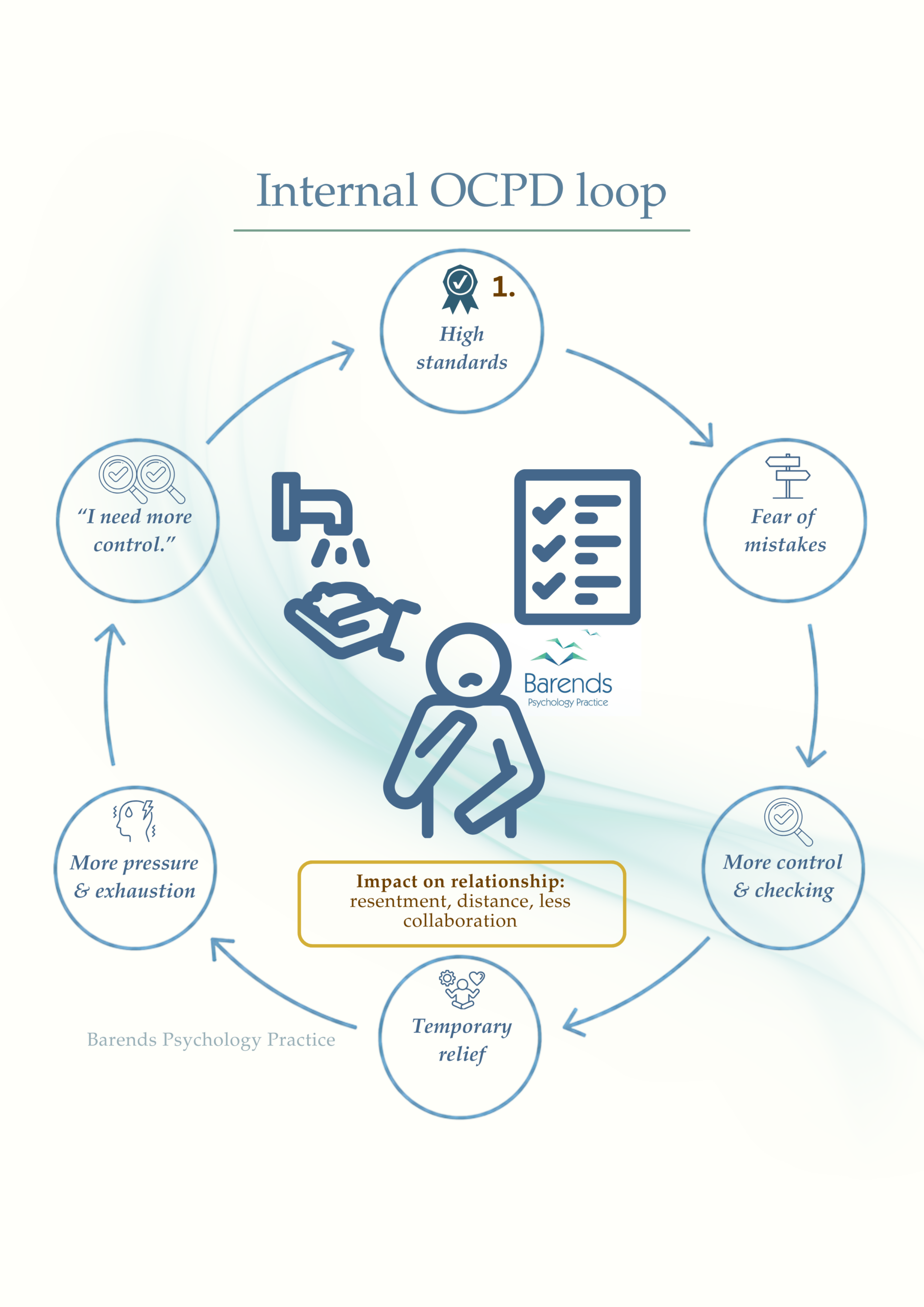
One reason Obsessive-Compulsive Personality Disorder (OCPD) can be difficult to change is that perfectionistic and controlling behaviour often provides short-term relief. When something feels uncertain, incomplete, or at risk of going wrong, checking, correcting, or taking control can create a temporary sense of safety.
That relief reinforces the original behaviour. The person learns that strict standards and increased control prevent mistakes, even when the same pattern also creates pressure, delays, or exhaustion. The next time uncertainty appears, they may respond with even more effort and control.
A simplified version of the internal OCPD loop looks like this:
- High standards are activated
- Mistakes or uncertainty begin to feel threatening
- Checking, correcting, or controlling increases
- Temporary relief follows
- Pressure, exhaustion, or frustration builds
- The belief becomes stronger: “I need to stay in control.”
The difficulty is that short-term relief hides the long-term cost. The person may become increasingly tired, less able to delegate, and more convinced that lowering their standards would be unsafe or irresponsible.
Treatment often focuses on creating more space between uncertainty and the automatic response. Learning to tolerate small mistakes, accept different approaches, and stop when something is good enough can gradually weaken the cycle without removing the strengths of responsibility and conscientiousness.
OCPD in Relationships
People with Obsessive-Compulsive Personality Disorder (OCPD) can be deeply committed, loyal, and responsible partners. They often show care by solving problems, keeping promises, organizing daily life, and making sure important responsibilities are handled properly.
Relationship difficulties usually do not arise from a lack of care. They tend to develop when responsibility, high standards, and practical support become rigid. A person with OCPD may believe they are protecting the relationship or preventing problems, while their partner experiences the same behaviour as criticism, control, or emotional distance.
These patterns can become more visible during periods of stress. When something feels uncertain or poorly organized, the person with OCPD may try to regain stability by correcting details, taking over responsibilities, or insisting that a task is completed in a particular way. Their partner may then feel micromanaged or unable to contribute freely.
Need for control
Wanting things done in a particular way can make a partner feel corrected, supervised, or unable to make independent decisions.
Perfectionism
Small mistakes may receive more attention than the effort or intention behind them. This can create pressure and make the relationship feel difficult to satisfy.
Practical care
Love is often expressed through responsibility, problem-solving, and reliability. A partner who needs emotional reassurance may not always recognize these actions as expressions of care.
Difficulty relaxing
Work, unfinished tasks, and responsibilities may continue to dominate attention, leaving less space for intimacy, spontaneity, or shared enjoyment.
The relationship feedback loop
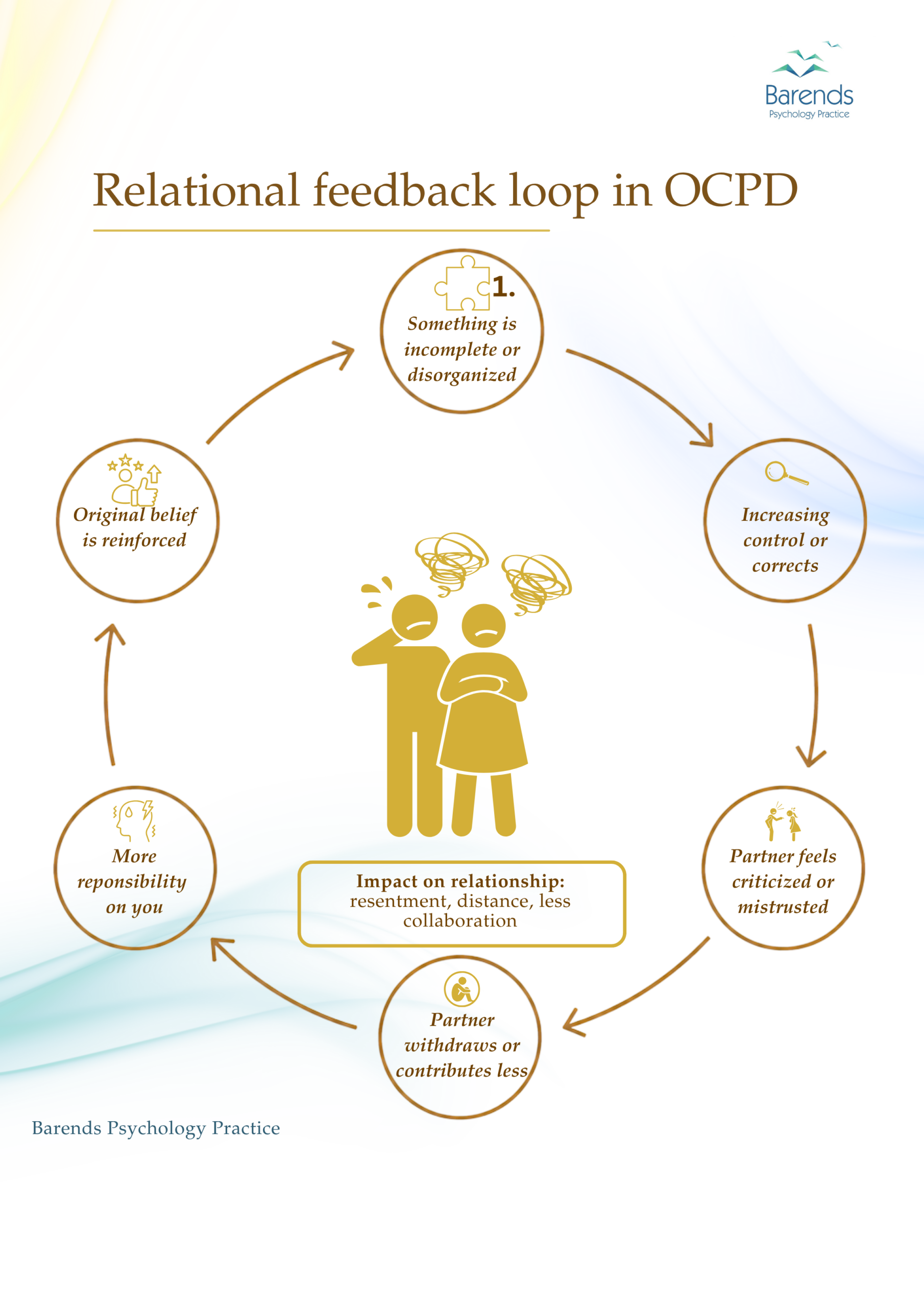
A common cycle begins when the person with OCPD notices something that feels incorrect, inefficient, or unfinished. They respond by correcting the situation, offering instructions, or taking over the task. This may provide temporary relief because the situation feels more controlled.
Their partner, however, may experience the response as criticism or a lack of trust. The partner may become defensive, withdraw, or stop taking initiative. The person with OCPD then sees less involvement or more mistakes, which reinforces the belief that they must remain responsible for everything.
- Something feels disorganized or incomplete
- The person with OCPD increases control or correction
- The partner feels criticized or mistrusted
- The partner withdraws or contributes less
- More responsibility falls on the person with OCPD
- The original belief is reinforced: “If I do not manage it, things will go wrong.”
Both partners can become trapped in this pattern. One feels overburdened and unsupported, while the other feels controlled and undervalued. Neither person may recognize that their reactions are strengthening the cycle.
Many people with OCPD are loving and devoted partners. The difficulty is usually not commitment itself, but the rigid way in which responsibility and care may be expressed. Developing greater flexibility, sharing control, and recognizing different ways of showing care can improve both emotional connection and relationship satisfaction.
Want to understand these patterns in more depth?
This section provides a general overview of how OCPD can affect close relationships. Our complete guide to OCPD and relationships explores communication, criticism, emotional intimacy, conflict, parenting, and practical strategies for both partners.
Why does OCPD look different from one relationship to another?
Not everyone with OCPD tries to create certainty in the same way. Some focus heavily on practical responsibilities, while others become rigid around emotional communication, routines, or personal development. The Relational Archetypes help explain how the same underlying need for control and predictability can appear through different relationship patterns.
Why OCPD Relationship Patterns Can Look Different From Person to Person
Obsessive-Compulsive Personality Disorder (OCPD) is associated with perfectionism, control, rigid standards, and difficulty allowing flexibility. However, these patterns do not appear in exactly the same way in every person.
One person may become highly focused on practical responsibilities, while another may try to control emotional conversations or insist that relationship problems are discussed in a particular way. The underlying need for certainty may be similar, but the way it is expressed can differ.
The Relational Archetypes provide a non-diagnostic way of understanding these differences. They describe what people naturally pay attention to in relationships and what helps them experience connection and security.
A Relational Archetype does not cause OCPD, and no archetype should be interpreted as a personality disorder. The framework can, however, help illustrate how perfectionism, control, and inflexibility may become expressed through different relationship patterns.
Relational Archetypes and Possible OCPD Patterns
| Relational Archetype | Natural relational focus | Possible expression when OCPD patterns are present |
|---|---|---|
| Reliability, practical care, and shared responsibility | May take excessive responsibility, struggle to delegate, or insist that practical tasks are completed according to a specific method. | |
| Stability, predictability, and security | May become highly attached to routines or expectations and experience changes in plans as unnecessarily disruptive. | |
| Understanding, reflection, and careful interpretation | May overanalyse decisions, search for the correct explanation, or delay responding until every detail has been considered. | |
| Growth, development, and meaningful change | May develop strict ideas about how the relationship should improve and become frustrated when a partner does not pursue change in the same way. | |
| Emotional connection, responsiveness, and mutual understanding | May feel responsible for managing the emotional climate and develop rigid expectations about how feelings or conflicts should be communicated. |





Example: A Builder and an Attuner
Imagine someone with strong Builder patterns who also experiences OCPD-related perfectionism. They may express love by taking responsibility, organizing daily life, and ensuring that practical matters are handled correctly. Their underlying message may be:
“I am taking care of us by making sure nothing goes wrong.”
Their partner may have stronger Attuner patterns and experience care primarily through emotional presence. When the Builder corrects how something is done or focuses on solving the problem, the Attuner may feel criticized or emotionally overlooked. Their experience may be:
“I do not need everything to be perfect. I need to feel that you understand me.”
The Builder may then increase their effort, offer more solutions, or take even more responsibility. The Attuner may ask for more emotional engagement. Both partners are trying to protect the relationship, but neither experiences the response they need.
When OCPD-related rigidity is present, it can become difficult for the Builder to accept that emotional support may matter more than correcting the situation. The Attuner may interpret this as a lack of care, even though the Builder experiences their practical effort as evidence of commitment.
Recognizing the pattern can help partners move away from arguments about who is right. The more useful question becomes:
“What are you trying to protect or provide through this response?”
The Relational Archetypes can support reflection and communication, but they cannot diagnose OCPD. Diagnosis requires a professional assessment of persistent personality patterns, their severity, and their effect on daily functioning.
Why do the same relationship patterns keep returning?
Perfectionism and control do not appear in the same way in every relationship. Your Relational Archetype helps explain what you naturally focus on, what you try to protect, and how your strengths may become more rigid under pressure.