


Relationship problems and communication: stonewalling in relationships
Stonewalling in relationships: when one partner shuts down
Why one partner stops responding and how silence can turn a disagreement into a painful relationship pattern
When a conversation suddenly becomes one-sided
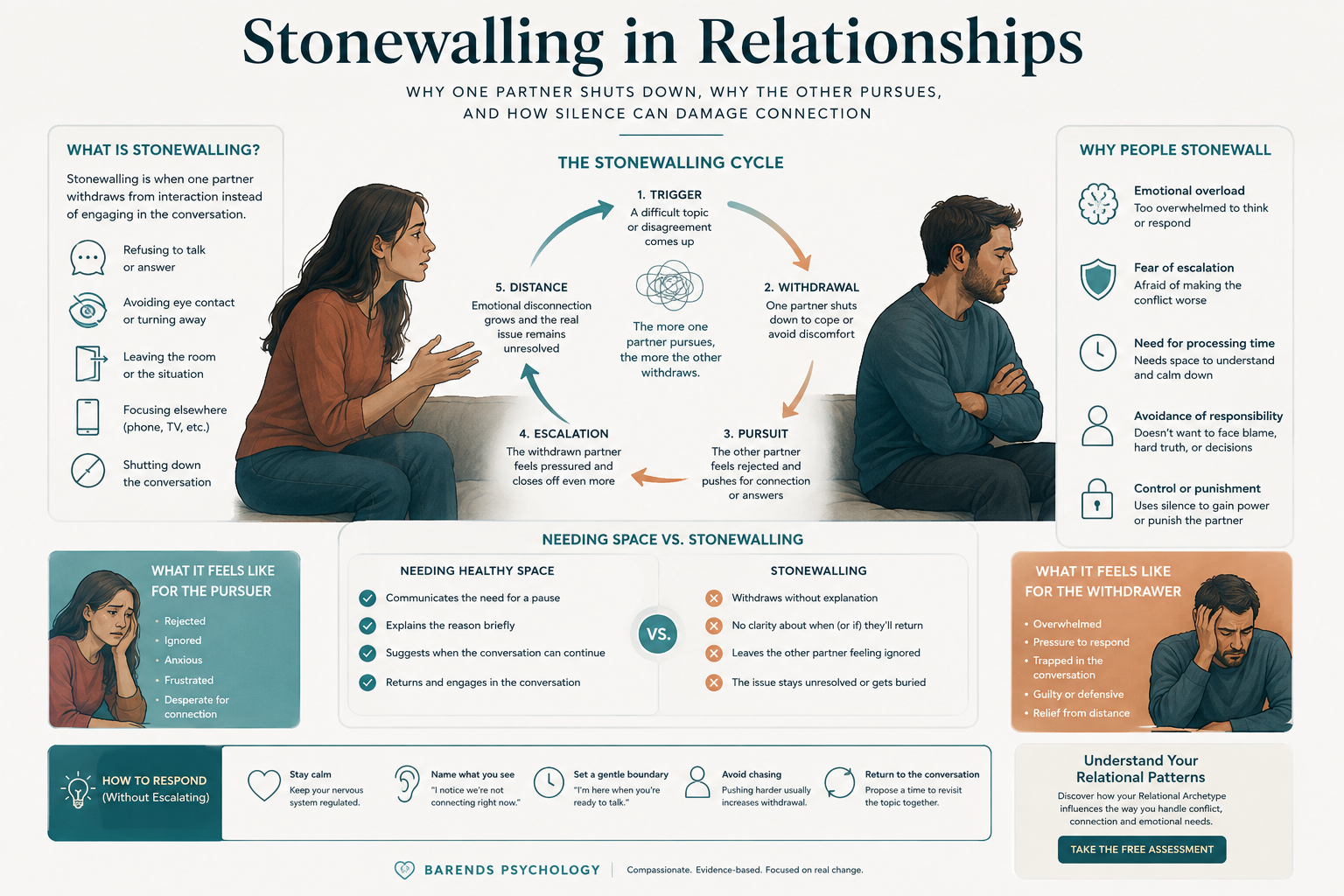
Stonewalling at a Glance
- Stonewalling in relationships means withdrawing from an interaction rather than continuing to engage.
- It may involve silence, avoiding eye contact, leaving, changing the subject, or refusing to respond.
- Some people stonewall because they feel emotionally overwhelmed or unable to organize their thoughts.
- Stonewalling may also be used to avoid responsibility or punish a partner.
- Taking space is healthier when the person explains what they need and agrees to return to the conversation.
- The more one partner pursues an answer, the more the other may withdraw, creating recurring relationship problems.
- Repeated stonewalling in relationships can weaken emotional safety, trust, and willingness to discuss difficult subjects.
Why do you and your partner respond so differently?
One person may need immediate contact after conflict, while the other needs time to think before responding. The free Relational Archetype Assessment helps you understand the emotional needs and communication patterns that shape these reactions.
On this page
- What is stonewalling?
- Signs of stonewalling
- Why people stonewall
- Needing space versus stonewalling
- The stonewalling feedback loop
- What it feels like for both partners
- Stonewalling and Relational Archetypes
- Observer and Attuner example
- How to respond to stonewalling
- When couples therapy may help
- Frequently asked questions
What is stonewalling in a relationship?
Stonewalling in relationships is a breakdown in communication in which one person stops responding to the other. The conversation may continue physically, but emotionally it has ended. One partner is still trying to make contact while the other has withdrawn behind silence or minimal responses.
Sometimes the withdrawal is obvious. A partner walks out of the room or announces that the conversation is finished. In other cases, the person remains present but gives short answers or behaves as though the other person is not speaking.
The defining feature is not silence by itself. People can be quiet while still listening and remaining emotionally present. Stonewalling involves a loss of participation. The person no longer shows that they are willing to hear or respond to what their partner is saying.
A common example
A woman tells her husband that she felt unsupported when he changed their weekend plans without discussing it with her. He initially says that the change was necessary, but when she tries to explain why it upset her, he sighs and stops answering.
She asks, “Can you please look at me?” He says, “There is no point talking about this.” She follows him into the kitchen because she does not want the issue to remain unresolved. He becomes even quieter and eventually leaves the house.
She experiences his withdrawal as proof that her feelings do not matter. He experiences her continued questions as pressure that gives him no room to think. Both respond to the other person’s reaction, and the original issue becomes secondary.
Common signs of stonewalling in relationships
Stonewalling in relationships may appear as a series of small actions that tell the other partner that further contact is unavailable.
Verbal stonewalling
- Refusing to answer questions.
- Giving only one-word replies.
- Saying, “Whatever,” or “I do not care.”
- Repeating that there is nothing to discuss.
- Changing the subject whenever the issue returns.
- Responding with sarcasm instead of engagement.
Nonverbal stonewalling
- Avoiding eye contact.
- Turning the body away.
- Looking at a phone or television.
- Leaving without explanation.
- Showing no visible response to distress.
- Continuing another activity while the partner speaks.
A single quiet moment does not define a relationship. The concern grows when withdrawal becomes the usual response to discomfort and when important subjects can no longer be discussed without one person disappearing from the interaction.
Why do people stonewall?
Stonewalling is often misunderstood. From the outside, it may appear that someone simply does not care enough to continue the conversation. In reality, people stop engaging for very different reasons. Some withdraw because they feel emotionally overwhelmed. Others fear making the situation worse, while some use silence to avoid responsibility or regain control of the interaction.
Understanding why someone withdraws is important because the same behavior can have very different meanings. A person who is overwhelmed may genuinely want to continue the conversation once they have calmed down. Someone who uses silence as a way to punish or manipulate their partner requires a very different approach.
1. Emotional flooding
One of the most common reasons people stonewall is that they become emotionally flooded. Their heart rate rises, stress hormones increase, and thinking clearly becomes more difficult. Rather than carefully listening to their partner, they may struggle to organize their own thoughts or even understand what they are feeling.
To the partner, this often looks like indifference. Internally, however, the person may simply feel overwhelmed; they may temporarily have lost the ability to communicate effectively.
This is often seen in people whose natural response is to process internally before speaking. For example, some individuals with a dominant Relational Observer pattern may withdraw because they need time to organize their thoughts. Their partner may experience this as emotional distance, even though the withdrawal is driven by overload rather than a lack of care.
2. Fear of making things worse
Some people have learned that conflicts easily escalate. They may worry that whatever they say will be criticized, misunderstood, or lead to a bigger argument. Remaining silent feels safer than saying something they might later regret.
Unfortunately, this often has the opposite effect. The quieter one partner becomes, the harder the other partner may try to reconnect, creating a pursue-withdraw cycle that increases tension for both people.
The other partner may respond in the opposite way. Someone with stronger Relational Attuner tendencies often experiences distance as a sign that the relationship itself is in danger. Rather than stepping back, they may ask more questions or try harder to reconnect. Although both partners are trying to reduce discomfort, their reactions unintentionally reinforce each other.
3. Needing time to process
Not everyone processes emotions at the same speed. Some people know almost immediately what they feel and want to discuss it. Others need hours or even a day before they fully understand their own thoughts.
This difference often appears between different Relational Archetypes. While an Attuner may experience talking as a way of understanding their emotions, an Observer may first need quiet reflection before they can explain what is happening internally.
When this need for processing is not communicated, the partner often experiences the silence as rejection rather than as a request for time.
4. Avoiding responsibility
Sometimes stonewalling in relationships serves a different purpose. Continuing the conversation may require admitting a mistake, apologizing, making a difficult decision, or changing behavior. By withdrawing, the person postpones that uncomfortable moment.
When this happens repeatedly, the other partner often feels left carrying the emotional responsibility for the relationship, while important issues remain unresolved.
5. Control or punishment
In some relationships, silence is used deliberately. A person may ignore messages, refuse to answer questions, or abruptly end conversations because they know this creates anxiety in their partner. The silence itself becomes a way of influencing the other person’s behavior.
This differs fundamentally from becoming emotionally overwhelmed. Rather than protecting themselves from distress, the person uses withdrawal to regain power within the relationship. When stonewalling is used in this way, it may form part of a broader pattern of unhealthy or emotionally controlling behavior.
| Possible reason | What may be happening internally | How it may look to the partner |
|---|---|---|
| Emotional overload | The person feels unable to think clearly or organize a response. | They appear indifferent or unwilling to listen. |
| Fear of escalation | The person expects that anything they say will make the conflict worse. | They appear unwilling to work on the relationship. |
| Need for processing time | The person needs distance before they understand what they think or feel. | The pause feels like emotional abandonment. |
| Avoidance of responsibility | Engagement would require acknowledging harm or changing behavior. | The partner feels dismissed and left to carry the issue alone. |
| Control or punishment | Silence is used to create anxiety or make the partner give in. | The partner feels punished and desperate for contact. |
Needing Space Versus Stonewalling in relationships
Not every pause during a disagreement is stonewalling. Some people genuinely need time to calm down, organize their thoughts, or understand what they are feeling before continuing a conversation. Taking healthy space can actually protect a relationship by preventing impulsive reactions, hurtful comments, or emotional escalation.
The difference lies in whether the person remains responsible for the connection. Healthy space includes explaining what is happening and reassuring the partner that the conversation will continue later. Stonewalling in relationships leaves the other person uncertain about what happened, why communication stopped, or whether the issue will ever be discussed again.
A common example
Emma and Tom are discussing household responsibilities. As the conversation becomes more emotional, Tom becomes increasingly quiet. He looks away, folds his arms, and eventually says,
“I can’t talk about this anymore.”
Emma follows him into the kitchen because she wants to solve the issue before going to bed. Tom becomes even quieter. Emma experiences this as rejection and feels increasingly anxious. Tom experiences Emma’s questions as additional pressure and withdraws even further.
Neither partner intends to hurt the other. They simply interpret the same situation through different relational needs.
The Attuner and the Anchor
This difference often appears between the Relational Attuner and the Relational Anchor. Neither archetype is naturally a stonewaller. However, they often experience conflict very differently.

The Attuner
The Attuner naturally pays attention to emotional connection. When a partner suddenly becomes quiet or emotionally unavailable, the Attuner often experiences this as meaningful information about the relationship itself. Rather than waiting, they usually try to restore connection by asking questions, seeking reassurance, or continuing the conversation.
When the Attuner needs space:
- Usually explains why.
- Offers reassurance.
- Suggests returning later.
- Still wants the partner to feel emotionally connected.
When the partner stonewalls:
- Feels ignored or rejected.
- Asks more questions.
- Tries harder to reconnect.
- Often wants immediate resolution.

The Anchor
The Anchor generally restores stability by reducing stimulation rather than increasing it. During emotionally intense conversations they may need quiet reflection before they can respond thoughtfully. Stepping away is often an attempt to prevent escalation rather than to reject their partner.
When the Anchor needs space:
- Becomes quieter.
- Needs time to think.
- Prefers fewer words.
- Returns once emotions have settled.
When the partner stonewalls:
- Initially gives the partner space.
- Assumes they need time.
- Eventually becomes frustrated by the lack of communication.
- Values clarity once enough time has passed.
Healthy space versus stonewalling in relationships
Neither the Attuner nor the Anchor is naturally a stonewaller. Both may occasionally need distance during conflict. Healthy space remains connected to the relationship through explanation, reassurance, and a clear intention to return. Stonewalling removes that connection and leaves the partner uncertain about what happens next.
| Healthy Space | Stonewalling |
|---|---|
| “I need some time to calm down before we continue.” | “I’m done. Leave me alone.” |
| Explains why a pause is needed. | Withdraws without explanation. |
| Suggests when the conversation can continue. | Leaves the partner uncertain whether the discussion will ever continue. |
| The pause protects the relationship. | The withdrawal ends or controls the interaction. |
| Returns and continues the discussion. | The issue remains unresolved because communication stops. |

Literature and References
The term stonewalling is widely used in relationship education. Scientific research more often studies withdrawal as part of the demand–withdraw communication pattern, in which one partner seeks engagement or change while the other avoids or ends the discussion.
-
Christensen, A., & Heavey, C. L. (1990).
Gender and social structure in the demand/withdraw pattern of marital conflict.
Journal of Personality and Social Psychology, 59(1), 73–81.
View publication
-
Baucom, B. R., McFarland, P. T., & Christensen, A. (2010).
Gender, topic, and time in observed demand–withdraw interaction in cross- and same-sex couples.
Journal of Family Psychology, 24(3), 233–242.
View publication
-
Baucom, B. R., et al. (2015).
The interpersonal process model of demand/withdraw behavior.
Journal of Family Psychology, 29(1), 80–90.
View publication
-
Eldridge, K. A., Sevier, M., Jones, J., Atkins, D. C., & Christensen, A. (2007).
Demand–withdraw communication in severely distressed, moderately distressed, and nondistressed couples.
Journal of Family Psychology, 21(2), 218–226.
View publication
-
Overall, N. C., Manser, R., Low, R. S. T., & Ogilvie, C. (2019).
Communication that is maladaptive for middle-class couples is adaptive for socioeconomically disadvantaged couples.
Journal of Personality and Social Psychology, 116(4), 582–609.
View publication
-
Rosen, N. O., Dubé, J. P., Bosisio, M., & Bergeron, S. (2025).
Do demand–withdrawal communication patterns during sexual conflict predict couples’ relationship satisfaction, sexual satisfaction, and sexual distress?
The Journal of Sex Research, 62(5), 787–799.
View publication
-
Wilde, J. L., et al. (2024).
Gender, attachment, and demand/withdraw patterns in the context of moderate couple conflict.
Journal of Marital and Family Therapy.
View publication
Evidence note: Withdrawal is not always harmful in exactly the same way. Its meaning depends on intention, duration, communication, context, and whether the person returns to the discussion. A temporary and clearly communicated pause may help de-escalate conflict. Repeated withdrawal that prevents resolution or controls the partner is a different pattern.
Frequently asked questions
Frequently Asked Questions About Stonewalling in relationships
These questions explain how to recognize stonewalling, how it differs from taking space, and what partners can do when withdrawal has become a recurring pattern.
What is stonewalling in a relationship?
Stonewalling occurs when someone stops participating in an interaction. They may become silent, avoid eye contact, leave the room, focus on another activity, or refuse to respond. The defining feature is not silence alone, but the loss of meaningful engagement.
Is stonewalling the same as needing space?
No. Healthy space includes an explanation, some reassurance, and a clear intention to return to the conversation. Stonewalling leaves the partner uncertain about why communication stopped and whether the subject will ever be discussed again.
Why does my partner stonewall me?
A partner may withdraw because they feel emotionally overwhelmed, need time to process, fear making the conflict worse, or expect criticism. In other situations, stonewalling may help someone avoid responsibility or control the interaction. The wider relationship pattern is important when trying to understand the reason.
Is stonewalling emotionally abusive?
Stonewalling is not automatically emotional abuse. Someone may shut down because they feel flooded or lack the skills to stay engaged. It becomes more concerning when silence is deliberately used to punish, frighten, isolate, or control a partner, especially when it forms part of a wider pattern of coercive behavior.
What should I do when my partner stonewalls me?
Avoid repeatedly demanding an immediate answer when your partner is overwhelmed. State what you observe, ask whether they need a pause, and agree on a specific time to continue. You can respect a need for space without accepting indefinite silence or allowing important issues to disappear.
How long should a break during an argument last?
There is no single duration that suits every couple. The break should be long enough for both people to settle, but specific enough that the waiting partner is not left in uncertainty. Agreeing on a time later that day or the following day is usually clearer than saying, “We will talk sometime.”
Can someone stonewall without realizing it?
Yes. Some people learned to become quiet or leave during conflict and may experience this reaction as automatic. They may not understand how strongly their silence affects their partner until the pattern is discussed directly.
Why does stonewalling make me pursue my partner more?
Silence creates uncertainty. You may ask more questions or seek reassurance because you are trying to restore contact and resolve the threat to the relationship. Unfortunately, increased pursuit can make an overwhelmed partner withdraw further, creating a demand–withdraw cycle.
Can Relational Archetypes explain stonewalling?
Relational Archetypes can help explain why one person seeks connection while another seeks stability or time to process. They do not predict that a person will stonewall and should not be used to excuse harmful behavior. They offer a way to understand how partners interpret the same silence differently.
When can couples therapy help with stonewalling?
Couples therapy may help when withdrawal repeatedly prevents important conversations, the pursuing partner feels increasingly desperate, or both partners have lost confidence that disagreements can be resolved safely. Therapy can help identify the cycle, create safer pauses, and establish a reliable way to return to difficult subjects.